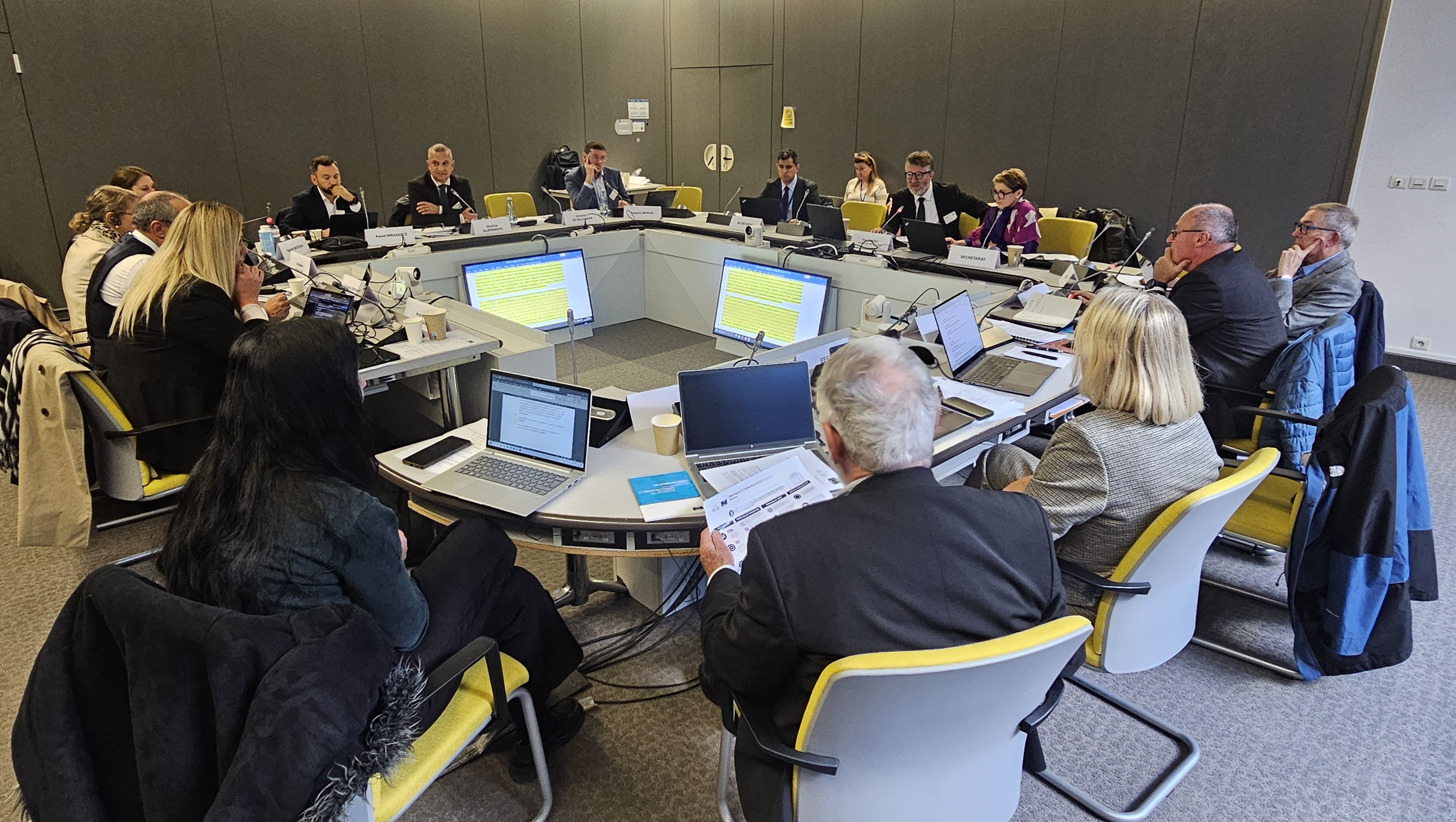
The UIHJ, represented by its 1st Vice-President, Jos Uitdehaag, and its Honorary 1st Vice-President, Mathieu Chardon, participated in the 2nd meeting of the CEPEJ working group on the Effectiveness of Judicial Proceedings.
The meeting was chaired by CEPEJ-GT-EFF President, Ivan Crnčec (Croatia) with the participation of its members, Ana Bilić-Andrijanić (Bosnia & Herzegovina), Francesco Depasquale (Malta), President of the CEPEJ, Ombeline Mahuzier (France), Sabine Matejka (Austria), and Pawel Wrzaszcz (Poland), as well as its experts, Kaspars Berkis (Latvia), Christian de Valkeneer (Belgium), and Dimitrije Sujeranovic (Serbia), along with Eva Konecna, Secretary to the group, and Ervilda Smajlaj, Assistant. The items on the agenda were addressed in turn.
First, within the scope of the mandate given by the CEPEJ to the GT-EFF to revise existing CEPEJ tools concerning the enforcement of court decisions, the EFF working group tasked Ana Bilić-Andrijanić, Mathieu Chardon, Francesco Depasquale, Patrick Gielen, Guillaume Payan, and Jos Uitdehaag, in collaboration with Eva Konecka, with revising the CEPEJ Guidelines of 17 December 2009 on the enforcement of judicial decisions in civil and commercial matters.
The on-going work was presented by Mathieu Chardon and Jos Uitdehaag. They explained that the recast of the Guidelines considers the numerous legislative, jurisprudential, technical, and practical developments that have occurred since the initial 2009 version. The new Guidelines incorporate significant input from the case law of the European Court of Human Rights. Substantial updates have been made regarding topics already covered in the previous version. Several new subjects have also been addressed, including alternative enforcement methods, cross-border enforcement, protection of personal data obtained and processed by enforcement agents, enforcement against digital assets, cybersecurity, use of artificial intelligence tools by enforcement agents, and electronic auctions. Following a highly productive exchange of views among the participants, the GT-EFF agreed that the current draft should be submitted to the CEPEJ for adoption during its 47th Plenary Meeting, to be held in Strasbourg on 3-4 December 2026.
The Guidelines for implementing workload measurement systems in courts were then discussed, following their presentation by the experts responsible for their development, Alexandre Palanco (France) and Ana Krnić-Kulušić (Croatia). A draft report on strengthening the Resource Centre on backlog reduction practices was subsequently presented by Andreja Petrovic (Serbia). Following this, Marie-Paule Lugbull, Head of the Management and Professional Development Unit at the National School for the Judiciary of France (ENM), and Camille Durez and Pedro Raposo de Figueiredo from the European Judicial Training Network (EJTN) presented their respective model training curriculum on efficient court management and the on-going projects in this matter. This was followed by an exchange of views and an agreement on the way forward.
Olivier Chevet, Head of Studies and Research at the Robert Badinter Institute (France), and Elise Laurent (France), sociologist and researcher, chaired their findings on their work on from the study “Judicial independence in the French-speaking world: risk factors and protective factors” they led with a view to modelling the independence of the judiciary through mechanisms of risks and safeguards. This was followed by an exchange of views regarding the draft questionnaire and an agreement on the way forward. This sequence was followed by a presentation by Dimitrije Sujeranovic of the checklist for efficient, effective, ideal and modern administrative and judicial court management. Finally, the GT-EFF discussed potential tools aimed at reducing duration of judicial proceedings, and Sabine Matejka shared an update on the on-going work on a work-life balance tool.