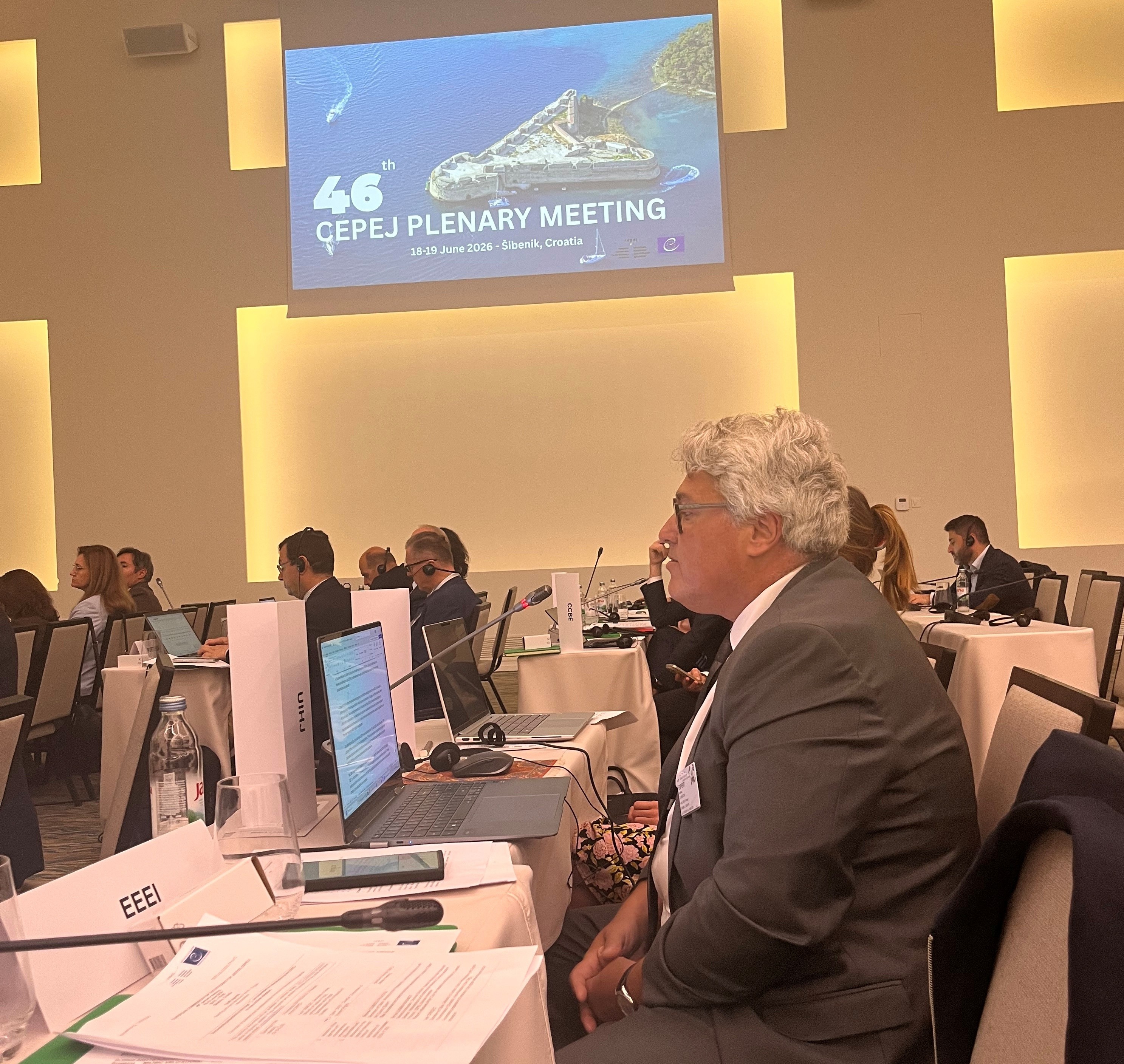

The UIHJ, represented by its Honorary First Vice-President, Mathieu Chardon, participated in the 46th CEPEJ Plenary Meeting in Šibenik, Croatia, on 18 and 19 June 2026.
Francesco Depasquale, President of the CEPEJ, welcomed the one hundred participants from the Council of Europe member states, the invited states, and the observer members. He announced that the meeting would provide an opportunity to discuss the various items on the agenda, focusing on technology, with a view to enhance the effectiveness of justice, and not replace it.
Ivan Crnčec, State Secretary for Justice of Croatia and Vice-President of the CEPEJ, welcomed the participants to Šibenik on behalf of the Croatian Minister of Justice, who was unable to attend. Claire Ovey, Director of the Council of Europe’s Directorate General Human Rights and Rule of Law, expressed her gratitude to the Croatian authorities and its Ministry of Justice. She also thanked Muriel Décot, Executive Secretary of the CEPEJ, and her team for their work. She stated her conviction that the upcoming exchanges and discussions would aim to ensure a more efficient justice system, serving those seeking justice, particularly through the judicious use of artificial intelligence and the automation of the justice system.
A roundtable was organised on the opportunities and limits of automation in judicial processes. Manuel Olmedo Palacios, Spanish Secretary of State for Justice, presented the progress made in the field of judicial automation in Spain, particularly on repetitive tasks (Robotic Process Automation). Sonya Djemni-Wagner, Advocate General at the Court of Cassation (France) and member of the CEPEJ Bureau, presented the recent initiatives of the Court of Cassation and the French Ministry of Justice in this area. She argued that automation should enhance the efficiency of judges without diminishing their powers. Ivan Crnčec focused on the automated preparation of decisions and fully digital personal bankruptcy procedure in Croatia. Margit Lauri, advisor to the Estonian Ministry of Justice and Digital Affairs, then presented the progress of the fully digitalisation of courts with artificial intelligence in her country.
Various CEPEJ delegations and observer members informed participants of significant developments in their countries or organisations since December 2025. In this regard, Mathieu Chardon reported that the UIHJ recently established an interprofessional working group on artificial intelligence with the CCBE, the Council of the Notaries the European Union, the European Association of Judges, and the European Union of Court Clerks. Two meetings were held, in February and May 2026. This working group aims for long-term cooperation in this area among these organisations. A common platform has been set up to share all documents, case law, training materials, research, legislation, etc. He then mentioned the 19th World Day of the Judicial Officer, which was celebrated worldwide on 11 June 2026, under the theme: “The Judicial Officer: A Field Actor in a Changing World.” This day provided an opportunity to organise national and local events on this theme in UIHJ member countries and to raise awareness of the profession. Finally, he announced that the 26th International Congress of Judicial Officers will be held in Lisbon from 28 to 30 April 2027, under the theme: “The Judicial Officer: A Pillar of Modern, Humane, and Effective Justice.” He invited the CEPEJ members to participate in large numbers.
The CEPEJ welcomed a new observer member: ENJIS (European Network of Judicial Inspection Services), represented by Artur Metani (Albania). Established in 2017, its purpose is to coordinate how national justice inspectorates operate, compare varying institutional frameworks, and foster common principles of independence, ethical conduct, and professional discipline across European judicial systems. Its members are Albania, Belgium, Bulgaria, France, Italy, Moldova, Portugal, Romania, and Spain.
Jaša Vrabec (Slovenia) presented the ongoing work of the CEPEJ Working Group on the Evaluation of Judicial Systems (CEPEJ-GT-EVAL), which he chairs. He discussed the preparation of the first annual evaluation report for 2026 (2025 data), the first thematic report, the preparation for the 2027 Evaluation Cycle (2026 data), and cooperation with the European Union within the framework of the European Justice Scoreboard. Co-operation with Moldova and Ukraine was also addressed by the concerned CEPEJ managers.
João Arsenio de Oliveira, Chair of the CEPEJ Working Group on Quality of Justice (CEPEJ-GT-QUAL), discussed the various ongoing projects of this group: quality interpretation in judicial proceedings, revision of the Handbook on conducting satisfaction surveys amongst court users, charter for promoting user’s trust and human-centred justice, mediation and other work of mandate. Co-operation activities relating to the quality of justice and mediation in Albania, Azerbaijan, and Morocco were also presented by the concerned CEPEJ managers.
The 2026 edition of the Junior Prize for the Crystal Scales of Justice and the winning project were then presented by Maria Civinini (Italy), Chair of the Jury.
Jeannette Verspui (Netherlands), discussed the ongoing work of the CEPEJ Working Group on Cyberjustice and Artificial Intelligence (CEPEJ-GT-CYBERJUST), which she chairs: a draft model technology curriculum for judges, the second report on the use of artificial intelligence in the judiciary based on the information contained in the CEPEJ Resource Centre on Cyberjustice and AI, a concept note for a judicial AI observatory, and other work of the mandate. Co-operation activities relating to Cyberjustice and AI in Albania and in Bosnia and Herzegovina were also addressed by the concerned CEPEJ managers.
Ivan Crnčec then addressed the work of the CEPEJ Working Group on the Effectiveness of Judicial Proceedings (CEPEJ-WG-EFF), which he chairs and which replaced the SATURN Group. He discussed the length of the stages of civil proceedings, the Resource Centre on backlog reduction practices, the guidelines for implementing court workload measurement systems in court, the checklist for effective court management, the training curriculum on effective court management and other work of the mandate. Co-operation activities relating to the effectiveness of judicial proceedings in Georgia, Greece, and Kosovo* were also presented by the concerned CEPEJ managers.
Regarding the revision of the CEPEJ Guidelines on Enforcement, Mathieu Chardon presented the ongoing work of the CEPEJ task force, of which he is a member together with Ana Bilic, Francesco Depasquale, Patrick Gielen, Eva Konecna, Guillaume Payan and Jos Uitdehaag. He recalled that the Council of Europe has been closely monitoring the enforcement of court decisions since the European Court of Human Rights’ judgment in Hornsby v. Greece of 19 March 1997. This judgment recognises that the enforcement of court decisions is an integral part of the right to a fair trial, as enshrined in Article 6 of the European Convention on Human Rights. He added that the Council of Europe formalised its reflections on this issue by adopting Recommendation Rec(2003)17 on the enforcement of court decisions of 9 September 2003.
In parallel, in the Pini and others v. Romania judgment of 22 June 2004, the European Court of Human Rights held that enforcement agents “work to ensure the proper administration of justice and thus represent a vital component of the rule of law”. Then, on 17 December 2009, the CEPEJ adopted the Guidelines for a better implementation of this Recommendation, drafted by the CEPEJ Working Group on Execution, of which he was a member. Mathieu Chardon confirmed that, since its adoption, the UIHJ has consistently promoted this fundamental tool, recognised as such not only in the member states of the Council of Europe, but also worldwide. However, and rightly so, he explained that the CEPEJ decided to update these guidelines, particularly considering the exponential technological developments the world is facing.
The ongoing work proposes, firstly, a comprehensive revision of the guidelines on enforcement and, secondly, the inclusion of new elements. The revisions to the text focus on the role of enforcement agents, the role of courts in enforcement, access to information, provisional and protective measures, social aspects of enforcement and data protection. New topics to be addressed in these future guidelines include the digitalisation of enforcement procedures and the use of artificial intelligence in enforcement procedures, cross-border enforcement, the use of mediation and alternative dispute resolution methods, enforcement on digital assets, and electronic auctions.
Seçkin Koçer (Turkey), member of the CEPEJ Bureau, finally presented the work of the CEPEJ ad hoc working group on work-life balance (ad hoc CEPEJ-GT-WLB), which he chairs.
Finally, at the close of a masterly organised meeting, Francesco Depasquale unannounced that the CEPEJ was soon going to celebrate its 25th anniversary. The UIHJ extends its warmest congratulations to the CEPEJ on this occasion and wishes it continued success in its work to improve the efficiency of the judiciary for many years to come.