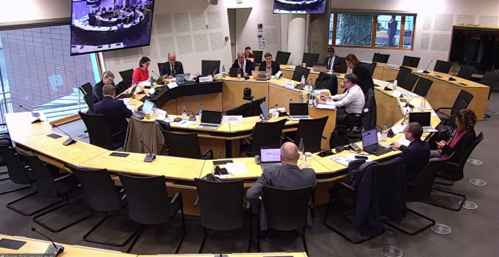
The UIHJ, represented by its First Vice-President, Jos Uitdehaag, and its Honorary First Vice-President, Mathieu Chardon, participated online in this meeting of the CEPEJ working group on Cyberjustice.
The meeting was chaired by Jeannette Verspui (Netherlands), Chair of the CEPEJ-GT-CYBERJUST, and was attended by other members of the working group: Kata Bencze (Hungary), Alejandro Fernández Muñoz (Spain), Marko Loisa (Finland), Bojan Muršec (Slovenia), Jan Spoenle (Germany), and deputy member Edmondo de Gregorio (Italy). Daniel Schmidt (Secretary of the working group), Ervilda Smajlaj (Assistant), Maria-Giuliana Civinini (Italy), scientific expert, as well as various CEPEJ experts and observers were also in attendance.
The meeting addressed the items on the agenda. Expert Terhi Esko (Finland) presented the progress on a study regarding the potential and limitations of automation within the judicial system. Jan Spoenle provided an update on the draft guidelines concerning judicial independence in the digital age through data sovereignty. Marek Świerczyński (Poland) and Alfonso Peralta (Spain) presented the draft guidelines on legal and practical implications of AI-generated ‘deep fakes’ emerging in the context of electronic evidence. All three presentations were followed by in-depth discussions among the participants.
Christel Schurrer, Deputy Secretary of the CEPEJ and Secretary of the CEPEJ Working Group on the Evaluation of Judicial Systems (CEPEJ-GT-EVAL), and Lidija Naumovska, CEPEJ statistician, discussed the implications of the reform to the CEPEJ’s judicial system evaluation cycle – which has transitioned from a biennial to an annual process – as well as the development of parallel thematic reports, including one on ICT development to be published in 2027 and the revision of the ICT questionnaire.
Regarding the CEPEJ Observatory on AI in Justice, Alejandro Fernández Muñoz reviewed the recent updates to the CEPEJ Resource Centre on Cyberjustice and AI, followed by a discussion on the revision of its concept notes and data fields. The draft programme for the annual conference of the European Cyberjustice Network (ECN), to be held in Strasbourg on 2 December 2026, was also unveiled.
Furthermore, Eva Konecka, Secretary of the CEPEJ Working Group on the Efficiency of Justice (CEPEJ-GT-EFF), expressed a desire to consult the CEPEJ-GT-CYBERJUST regarding the draft new guidelines on enforcement. This consultation focused specifically on sections concerning the use of artificial intelligence tools and cybersecurity in enforcement proceedings, the enforcement of digital assets, and electronic auctions. A productive discussion followed the presentation of this ongoing work.
Finally, various issues were addressed, including a report on the European Judicial Training Network (EJTN) summit on AI held on 28 September 2026 in Riga, a proposed survey within the European Cyberjustice Network regarding translation, a potential cooperation initiative with the European Law Students’ Association (ELSA France) in the field of AI, and a report by the European Institute for Expertise and Expert Institute (EEEI) on the use of artificial intelligence in judicial expertise.