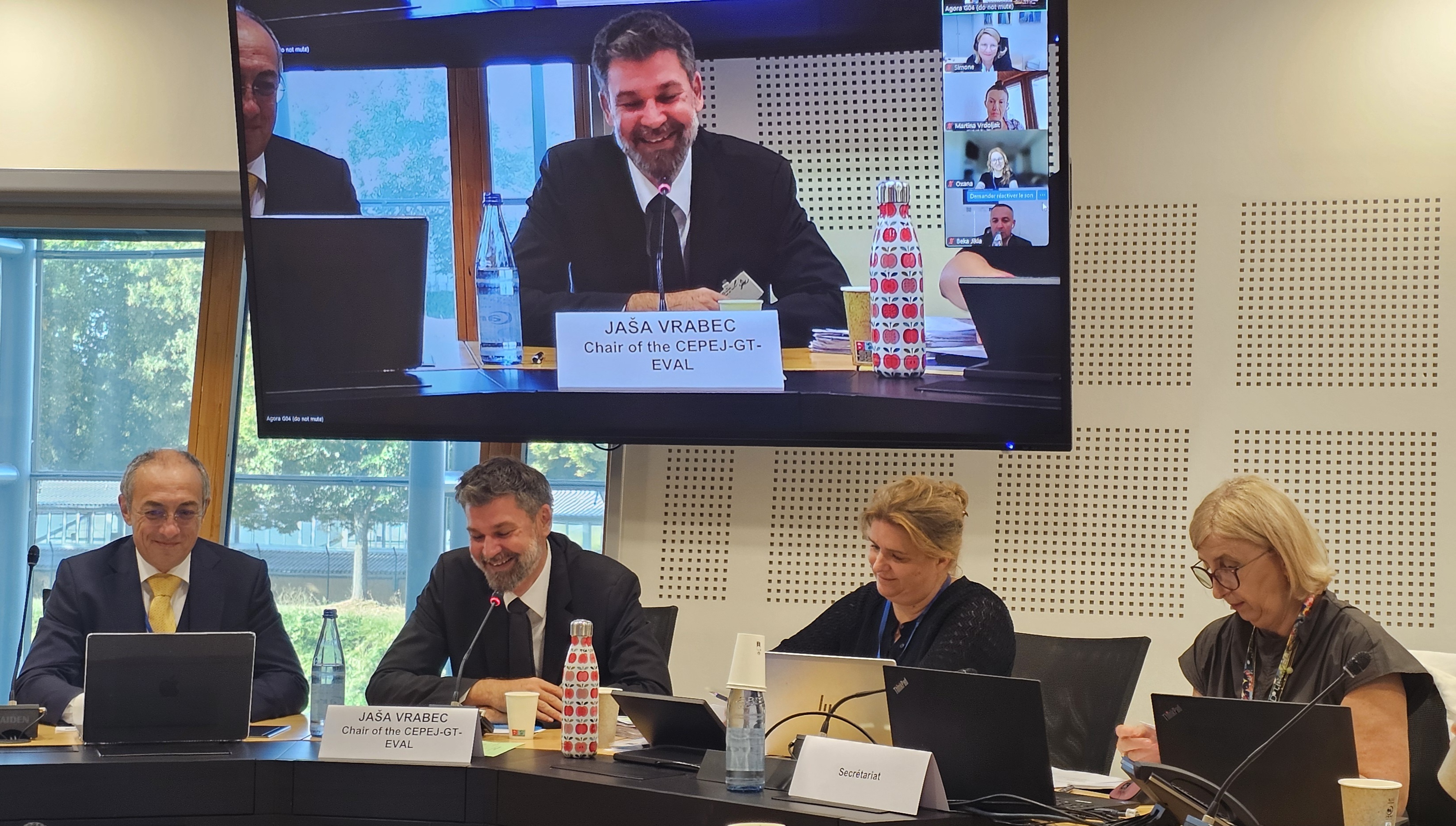
The UIHJ, represented by its Honorary First Vice-President Mathieu Chardon, participated in the 53rd meeting of the CEPEJ working group on the Evaluation of Judicial Systems. The meeting was chaired by its President, Jaša Vrabec and attended by CEPEJ President Francesco Depasquale.
At the outset, Francesco Depasquale reported on the highly productive meeting held on 7 September 2026 between the Bureau of the CEPEJ and the Bureau of the European Court of Human Rights (ECHR) to identify areas for future cooperation. The ECHR regards the CEPEJ evaluation reports on European judicial systems as highly significant. The CEPEJ President announced that direct cooperation between the two institutions is to be established. For more information: https://www.coe.int/en/web/cepej/-/meeting-between-the-cepej-bureau-and-the-bureau-of-the-european-court-of-human-rights-to-identify-areas-for-future-cooperation
The main task of the CEPEJ-GT-EVAL is the drafting of evaluation reports on European Judicial Systems, now on an annual rather than a biennial cycle. The 2026 CEPEJ Evaluation Report (based on 2025 data) will be presented for adoption during the 47th CEPEJ plenary meeting, scheduled for 3–4 December 2026 in Strasbourg. Its preparation was discussed at length during the meeting, covering the state of play of 2025 data collection, remaining question, the content of the first part (“European analyses”), the content of the 2026 country profiles and “European profile”, and the CEPEJ-STAT database.
The 2027 European judicial systems CEPEJ Evaluation Cycle (2026 data) was also discussed, specifically concerning the preparation of the 2027 questionnaire and the preparation of the first thematic report on ICT. A discussion also took place regarding coordination with other CEPEJ working groups: CEPEJ-GT-QUAL, on quality of justice indicator, CEPEJ-GT-EFF, on workload measurement indicator, and CEPEJ-GT-CYBERJUST, on thematic report.
Finally, the working group addressed ongoing cooperation with the European Commission, particularly concerning the Study for the European Commission on the functioning of judicial systems in the member States of the European Union (Justice Scoreboard) and Eurostat, the Dashboard Western Balkans, and the Dashboard Eastern Partnership countries.