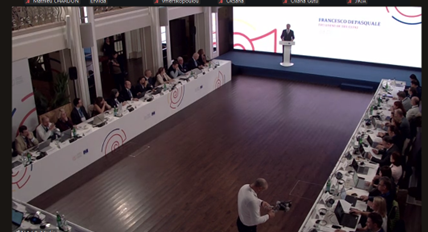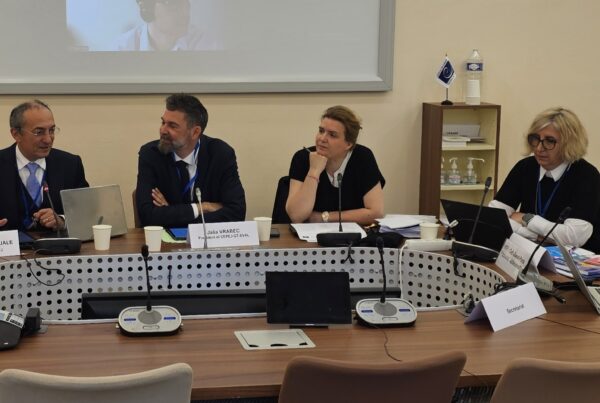

The theme of this meeting, held on 21 October 2025, in Valletta, was: “Towards More Effective And People-Centered Digitalised Justice in Europe: Facing Future Challenges“. The UIHJ was represented by its former First Vice-President, Mathieu Chardon.
The meeting came with those of the four CEPEJ working groups (GT-CYBERJUST, GT-EVAL, GT-QUAL, and SATURN), held on 20 and 22 October.
Francesco Depasquale, President of the Council of Europe’s European Commission for the Efficiency of Justice (CEPEJ), welcomed all participants. He expressed his pride that the first joint ad-hoc meeting of the CEPEJ working groups have been organised in his country, Malta, and he acknowledged the support of its Ministry of Justice. He thanked Muriel Décot, Secretary of the CEPEJ, and the CEPEJ Secretariat, as well as Daniele Cangemi, Head of the Department for Human Rights, Justice and Legal Cooperation Standard-setting activities at the Directorate General of Human Rights and Rule of Law of the Council of Europe. He spoke of the many challenges facing the Council of Europe and the CEPEJ faced with the erosion of the rule of law and trust in judicial institutions, and the constant pressures and attacks on the courts. He acknowledged that, despite the success of the CEPEJ’s work, it suffers from a lack of communication with the public, who are often unaware of its achievements. He believes that the CEPEJ, with its 23 years of existence and experience, is now invited, through its members, to look to the future in 2029. He expressed the hope that new ideas will emerge for an ever more efficient and qualitative justice system in the age of artificial intelligence, while keeping people at the heart of the process. He added that the meeting should contribute to achieving these ambitious objectives through discussions with experts from the working groups, the CEPEJ Bureau, and the observers.
Jonathan Attard, Minister of Justice of Malta, expressed his honour and pleasure in welcoming the CEPEJ to Malta. He recalled the long-standing collaboration between Malta and the CEPEJ, whose current President is Maltese, a source of great pride for his country. He expressed his pleasure in hosting the first joint meeting of all the CEPEJ working groups in Valletta, at a crucial time in the preparation of its 2026-2029 action plan. He reiterated that the rule of law is the cornerstone of democratic governance and social cohesion. For him, all reforms related to the digitalisation of justice and the use of artificial intelligence must be rooted in the principle of preserving the rule of law, strengthening it, and ensuring its accessibility for all. He wished the members of the CEPEJ fruitful work and a pleasant stay in Malta.
Daniele Cangemi then thanked the Maltese authorities for their welcome and support, particularly their Minister of Justice, as well as Francesco Depasquale, whose dynamism and commitment to the CEPEJ he praised. He recalled that, according to the CEPEJ’s statutes, its general mission is to observe, analyse and then decide. Article 2 of Resolution Res(2002)12 establishing the CEPEJ of 18 September 2002 provides that its purpose is to examine the results achieved by the different judicial systems, to define problems and areas for possible improvements and to exchange views on the functioning of the judicial systems, to identify concrete ways to improve the measuring and functioning of the judicial systems of the member States, having regard to their specific needs, or even to provide assistance to one or more member States, at their request, including assistance in complying with the standards of the Council of Europe. He then reported that the CEPEJ decided four years ago that it would be useful to have more time to accomplish its mission and to put in place an action plan over a period of four years. He added that one of the expectations of today’s meeting was to discuss, refine and clarify the outlines of this 2026-2029 action plan which, alongside the digitalisation of justice and artificial intelligence, should recall the fundamental principles of justice: respect for the rule of law, and justice which is people-centred around justice-users and justice professionals. He wished everyone fruitful work.
It should be noted that the CEPEJ currently comprises four working groups:
- The Working Group on the Evaluation of Judicial Systems of Council of Europe Member States (CEPEJ-GT-EVAL), chaired by Jaša Vrabec.
- The Working Group on the Quality of Justice (CEPEJ-GT-QUAL), chaired by João Arsenio de Oliveira.
- The SATURN Working Group on Judicial Time Management, chaired by Giacomo Oberto.
- The Working Group on Cyberjustice and Artificial Intelligence (GT-CYBERJUST), chaired by Maria-Giuliana Civinni.
After a presentation by each working group chair of their progress (Jeannette Verspui replaced Maria-Giuliana Civinni for the GT-CYBERJUST), a roundtable discussion was held on the major challenges facing justice. A rich and detailed discussion then allowed for the CEPEJ to detail and refine its main guidelines for its 2026-2029 action plan, which will be adopted during the 45th CEPEJ plenary meeting in December 2025. Discussions also addressed the development of the 2026-2027 activity program, as well as the work of the CEPEJ ad hoc Working Group on Work-Life Balance. The meeting was so successful that the CEPEJ President raised the possibility of organising joint meetings of its working groups every year.
Mathieu Chardon also attended the 39th meeting of the CEPEJ-GT-QUAL on 20 and 21 October. Its president, João Arsenio de Oliveira, engaged a brainstorming session to prepare for the next CEPEJ-GT-QUAL mandate and the meeting on 21 October, which gave rise to numerous discussions and proposals. During the debates, the CEPEJ Secretariat confirmed its intention to recast the CEPEJ Guidelines on Enforcement of 17 December 2009, to address the challenges of digitalisation of enforcement and artificial intelligence. The meeting also covered the various topics on its agenda: mediation, satisfaction surveys methodology, interpretation in judicial proceedings, access to justice, joint work with other CEPEJ working groups on improving work-life balance in the judiciary, and sustainable development in the judiciary.