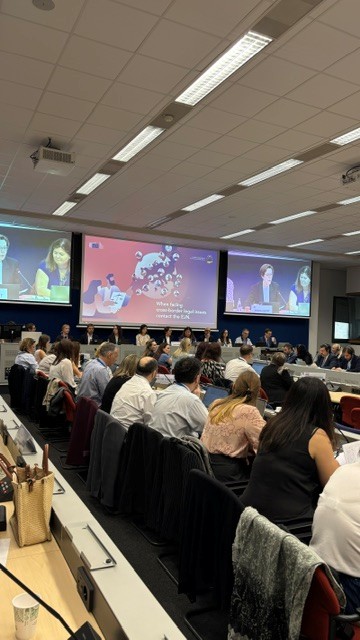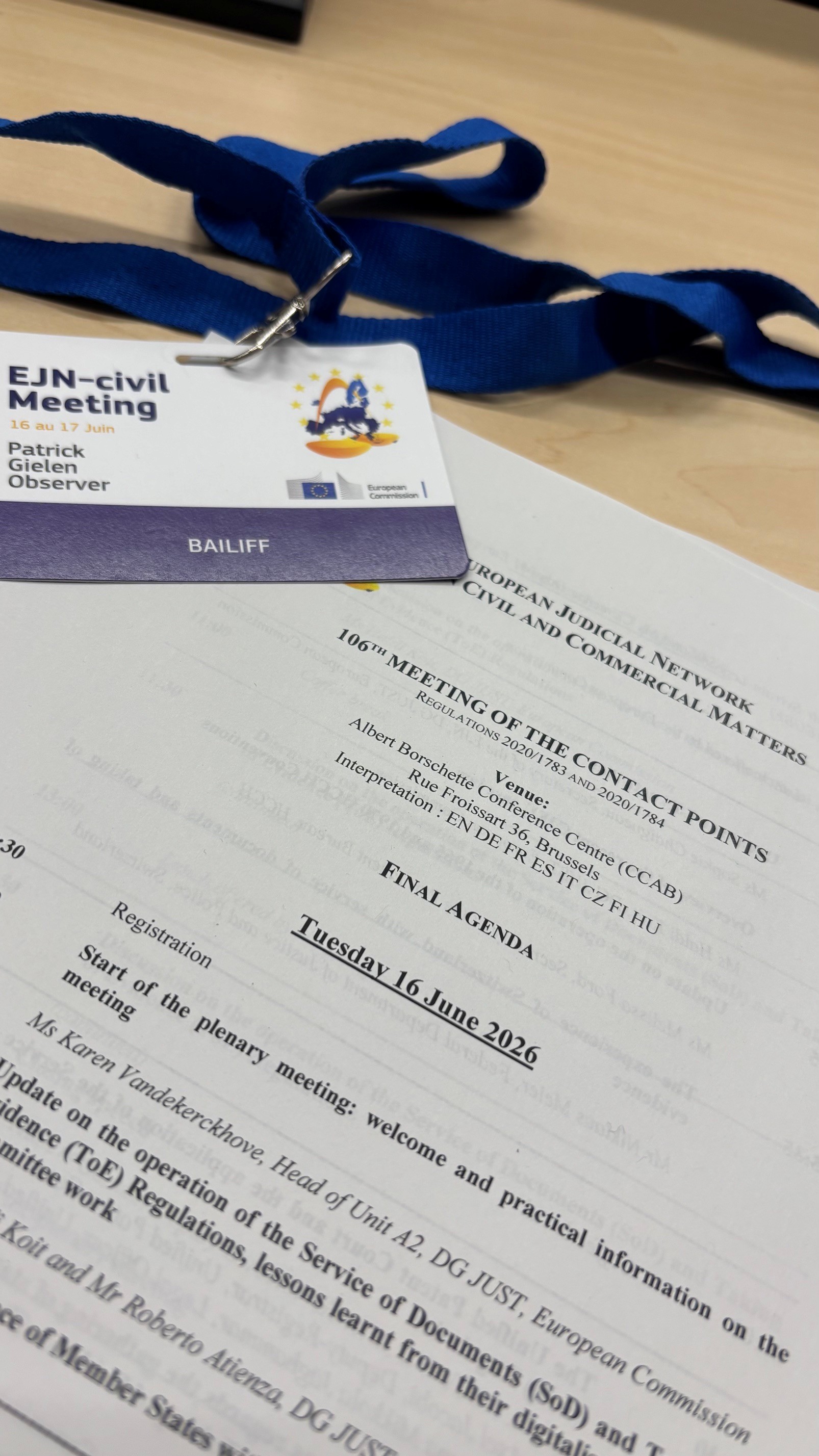
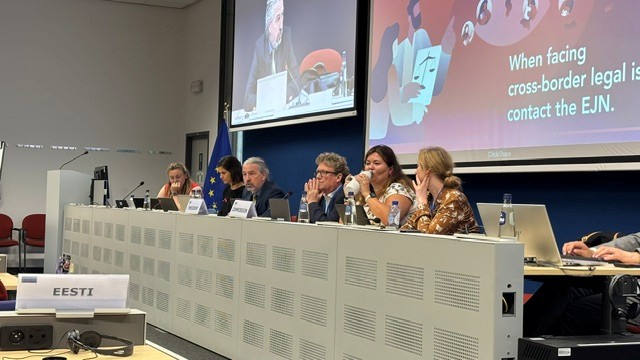
The International Union of Judicial Officers (UIHJ), represented by Patrick Gielen, Secretary-General, participated on 16 and 17 June 2026 in the 106th meeting of the contact points of the European Judicial Network (EJN) in civil and commercial matters, held at the Albert Borschette Conference Centre of the European Commission in Brussels. This landmark meeting, organised under the auspices of DG Justice (Karen Vandekerckhove, Head of Unit A2), brought together representatives of the Member States to take stock of more than one year since the mandatory implementation of the decentralised IT system JUDEX under the Service of Documents Regulation (EU) 2020/1784 and the Taking of Evidence Regulation (EU) 2020/1783.
JUDEX: the UIHJ defends the role of judicial officers in the platform
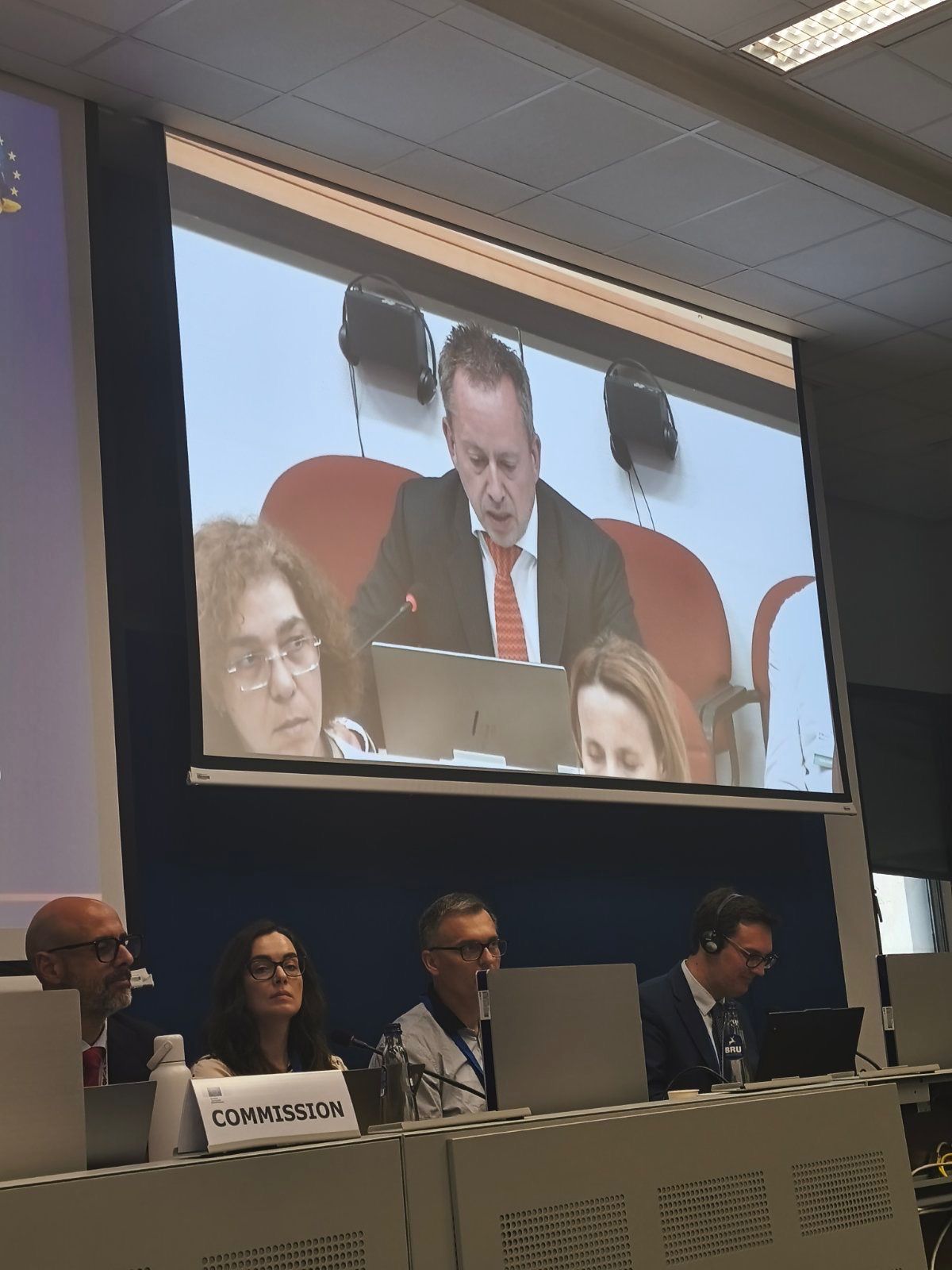
During the plenary session, Patrick Gielen took the floor to defend the role of the UIHJ in the use of the JUDEX platform. He immediately recalled a fundamental distinction that is too often overlooked in debates: sending a document via JUDEX from point A to point B in a secure manner is a technical act, whereas serving a document remains a legal act. The two realities must not be conflated, and this distinction is of paramount importance for the rule of law.
He then outlined the UIHJ’s concrete commitment since the launch of the platform: participation in the steering committee from the outset, creation of online training sessions in French and English available on the website, active partnership within the JODES project (Judicial Officers Data Exchange System), presented at the meeting by Sylvain Legrand and Clémence Dossier of the European Chamber of Judicial Officers, who have already implemented or contributed to the implementation of the system in five countries (Belgium, France, Greece, Portugal and Romania), and sustained promotion of JUDEX through the e-FILIT project, which trained more than 600 legal professionals over two years. The UIHJ has also submitted a new EU co-funded project for the creation of explanatory videos on e-Justice for legal professionals and citizens, to be made available in all EU languages.
Finally, he underlined the scale of the training challenge for the use of the JUDEX platform: in Belgium, between 700 and 800 judicial officer candidates and trainees need to be trained; in France, nearly 3,800 commissaires de justice spread across 2,208 offices throughout the country; in the Netherlands, 554 professionals all need to learn how to use this secure transmission platform. “Using JUDEX is not optional — it is mandatory,” he stated, calling for a sustained communication effort to make it a genuine success.
Other items discussed at the meeting
Over the course of the two-day meeting, a number of substantive legal questions relating to the application of the Regulations were also addressed. The UIHJ put forward its positions on the requirement for prior express consent for electronic service, on the transparency and predictability of service fees under the Service of Documents Regulation, and on identifying the address of the addressee in cases of multiple residences. The meeting further addressed Switzerland’s experience with cross-border service of documents, recent case law of the Court of Justice of the European Union, the work of the Hague Conference (1965 and 1970 Conventions), and the application of the Service of Documents Regulation by the Unified Patent Court.
Practice Guide on the Service of Documents Regulation: the UIHJ creates a dedicated working group to bring practitioners’ expertise
On the sidelines of the plenary, the Working Group on the drafting of a practical guide to the application of the Service of Documents Regulation, chaired by Apostolos Anthimos (Greece) and Burkard Hess (Germany), met on the late afternoon of 17 June. Patrick Gielen, along with other members, strongly advocated for the importance of practical expertise in this guide. He emphasised that such a document, to be genuinely useful, must be accessible to every legal practitioner, whether judge, court clerk, lawyer or judicial officer.
In this spirit, he announced the creation of a working group within the UIHJ, whose specific mission will be to bring this practical dimension to the guide currently being drafted. By pooling the experience of frontline professionals from across Europe, the UIHJ intends to contribute to the production of a concrete, practice-oriented tool, grounded in the reality of cross-border proceedings and reflecting the day-to-day challenges faced by practitioners in the Member States.
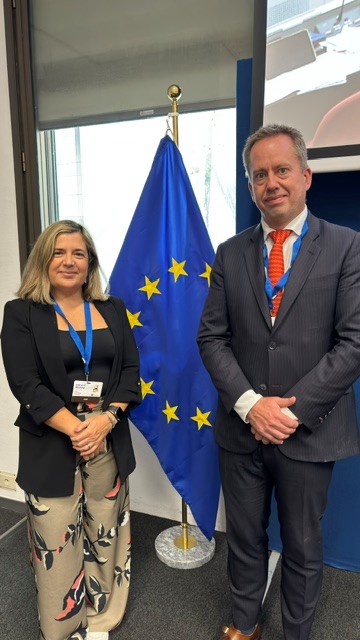
On the margins of the proceedings, Patrick Gielen met with Mara Fernandes, President of the Professional Council of the College of Enforcement Agents of the Ordem dos Solicitadores e dos Agentes de Execução (OSAE), the Portuguese professional body that regulates and supervises the professions of solicitador and enforcement agent in Portugal. This exchange is part of the reinforced cooperation between the UIHJ and its national partners, particularly in the run-up to the profession’s next major international gathering.
| SAVE THE DATE — XXVIth International Congress of the UIHJ — Lisbon / Estoril, April 2027
Registrations for the XXVIth International Congress of the UIHJ are now open. The congress will be held in April 2027 in Estoril (Lisbon), Portugal, under the theme “The Judicial Officer, Pillar of a Modern, Humane and Effective Justice”. To register and consult the programme: uihj-lisboa.com |