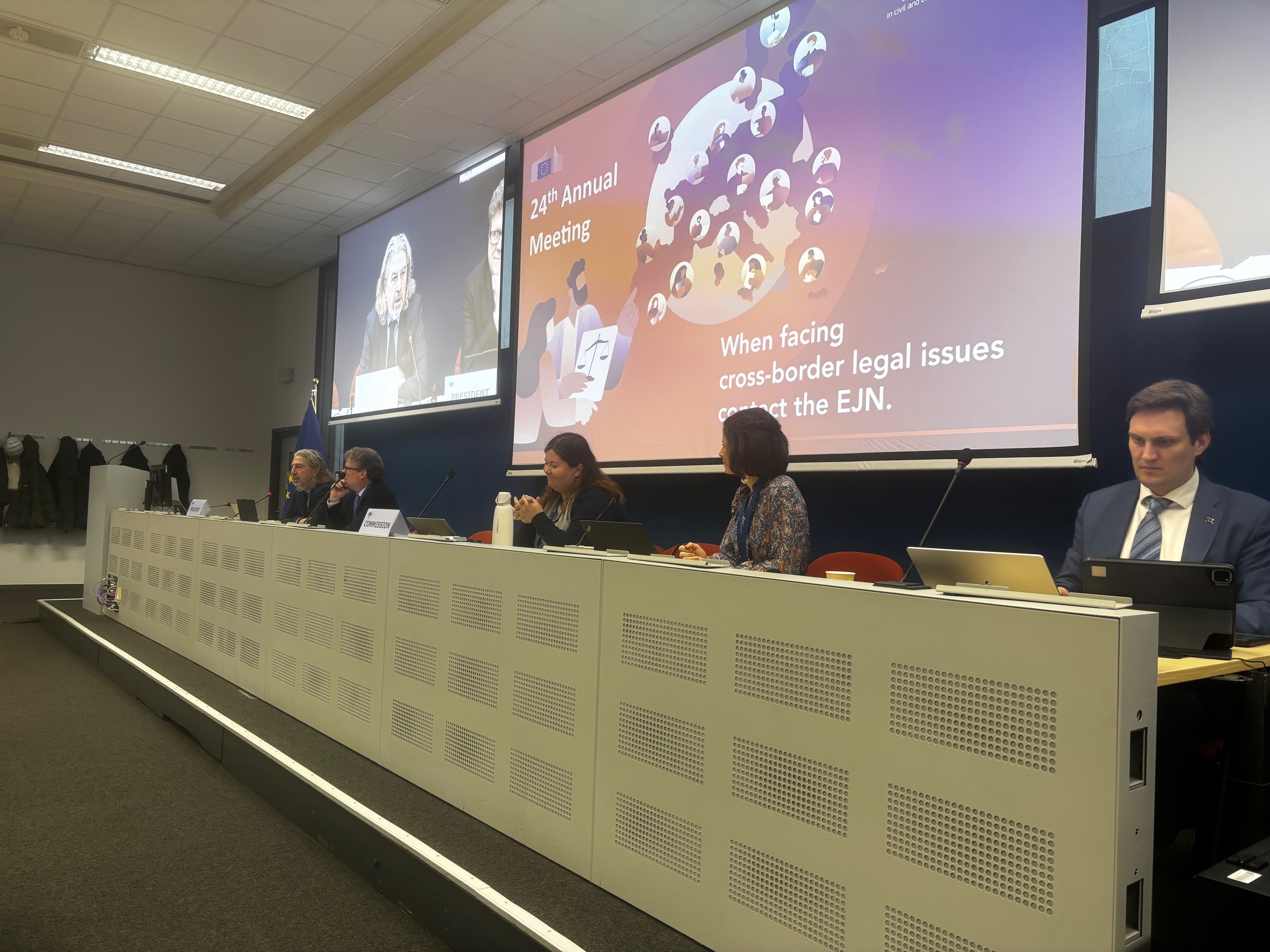

The International Union of Judicial Officers, represented by Patrick Gielen, participated in the 24th Annual Meeting of the European Judicial Network, which took place on 4–5 February in Brussels.
Prior to the annual meeting, a working group was held to prepare a Practice Guide on the application of the European Regulation on the Service of Documents. This group is led by Apostolos Anthimos and Burkhard Hess. The UIHJ is pleased to participate actively in this work, represented by its Secretary-General, thereby contributing to the operational and practical reflection surrounding the implementation of this essential instrument of European judicial cooperation.
This major event in the European judicial calendar brought together nearly 150 participants, including Network Contact Points, representatives of ministerial authorities, legal professionals, and several partner European organizations active in the field of cross-border civil and commercial judicial cooperation.
The meeting opened with a message from the European Commissioner for Democracy, Justice, the Rule of Law and Consumer Protection, Michael McGrath, who praised the essential role of the European Judicial Network in strengthening judicial cooperation among Member States and facilitating access to justice for citizens and businesses within the European Union.
Over the two days of discussions, exchanges focused on several strategic priorities for the future of civil judicial cooperation.
Highlights included a review of the Network’s activities in 2025, updates from ongoing working groups, and presentations on the Network’s visibility, court staff, European regulations on succession matters, and the digitalization of the Brussels IIb Regulation. Attention was also given to the development of practical guides relating to the application of the Regulations on the Service of Documents and on the Taking of Evidence.
The second day was largely devoted to the training of justice professionals and to the future of civil judicial cooperation. Participants attended presentations on the European Judicial Training Strategy 2025–2030, the opportunities offered by the European Judicial Training Network, and several national initiatives illustrating best practices in capacity building.
Discussions also addressed ongoing civil justice initiatives, the outcomes of the High-Level Forum “Justice for Growth,” as well as the strategy for the digitalization of justice and progress on digital projects supporting cross-border judicial cooperation.
The presentation of the report on the application of the Brussels Ia Regulation and the perspectives ahead concluded the plenary proceedings, followed by a restricted session dedicated to a communication workshop for Network Contact Points.
Finally, the UIHJ wishes to warmly thank the European Commission, and in particular Ms. Haldi Koit and Ms. Sophie Chaigneau, for the high quality of the organization of this annual meeting, the richness of the exchanges, and their constant commitment to strengthening European civil judicial cooperation.
Through its active participation, the UIHJ reaffirms its commitment alongside European institutions and all practitioners to promoting a more efficient, more accessible justice system fully adapted to contemporary cross-border challenges.