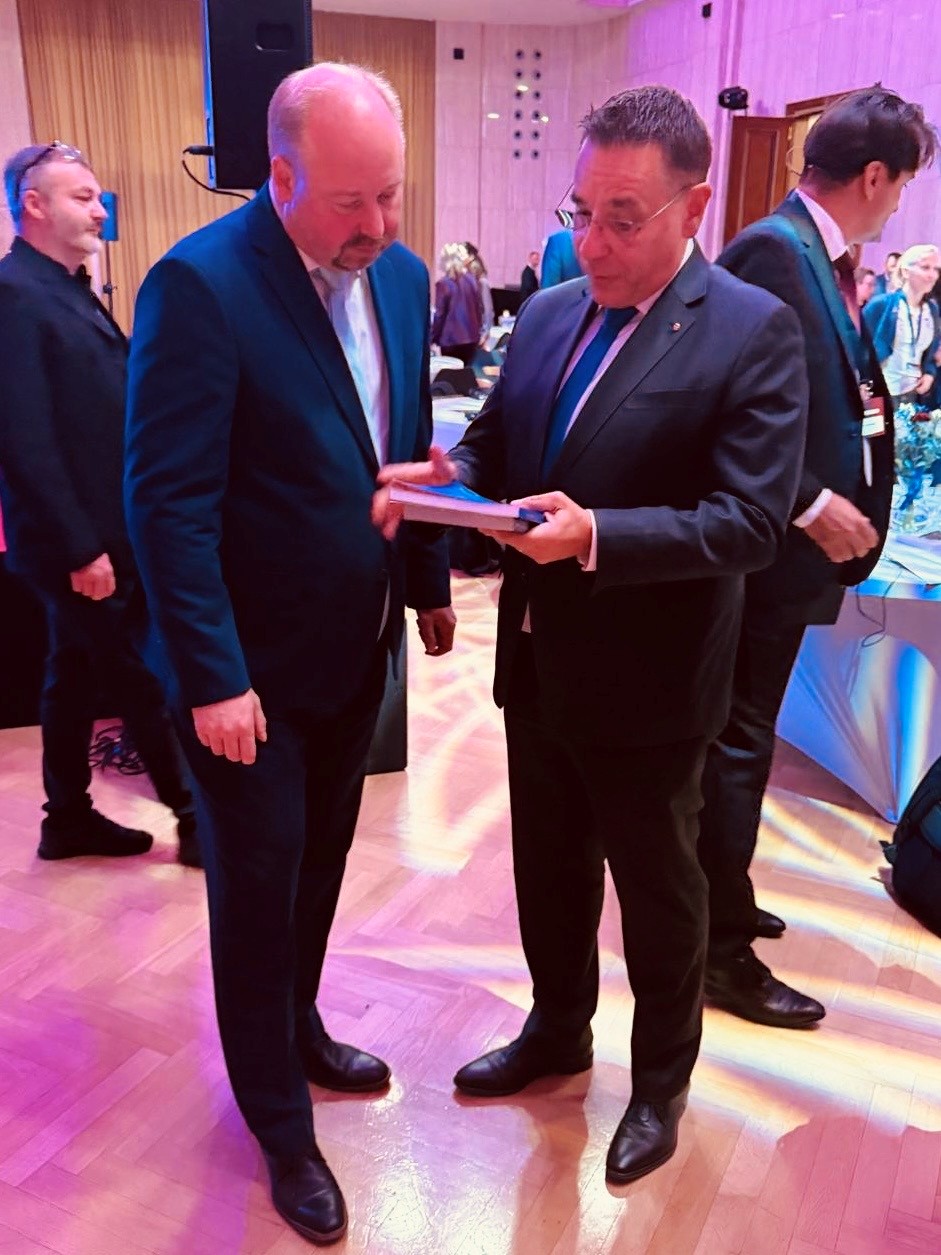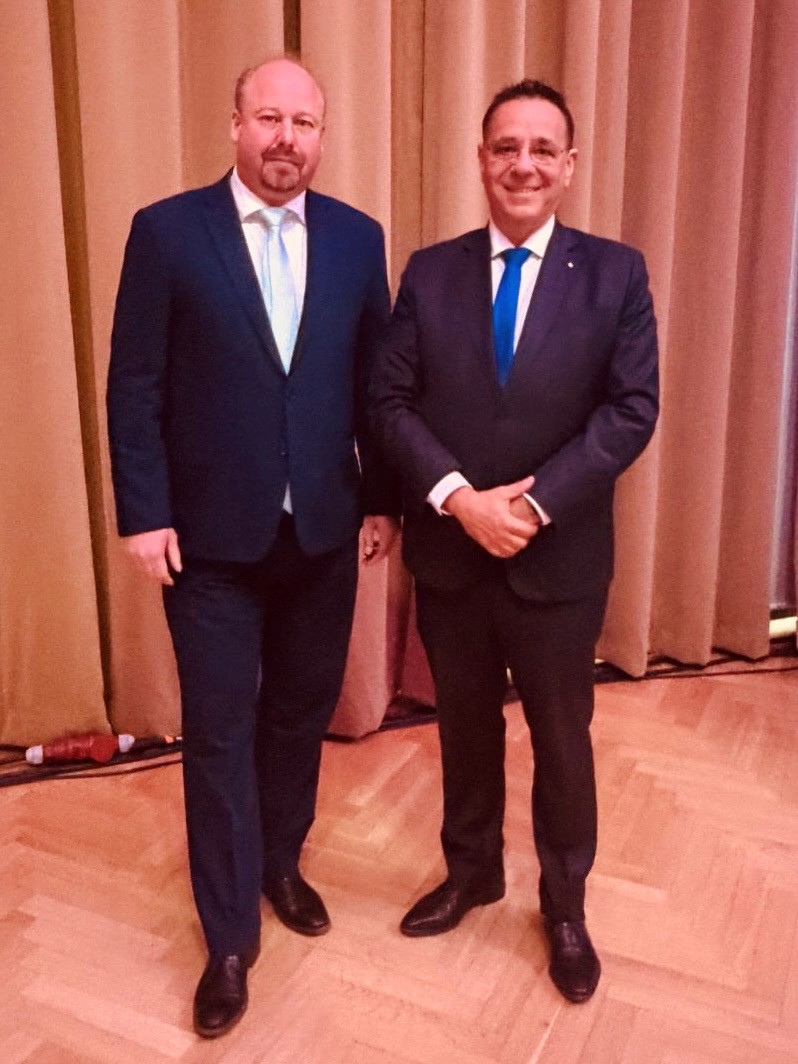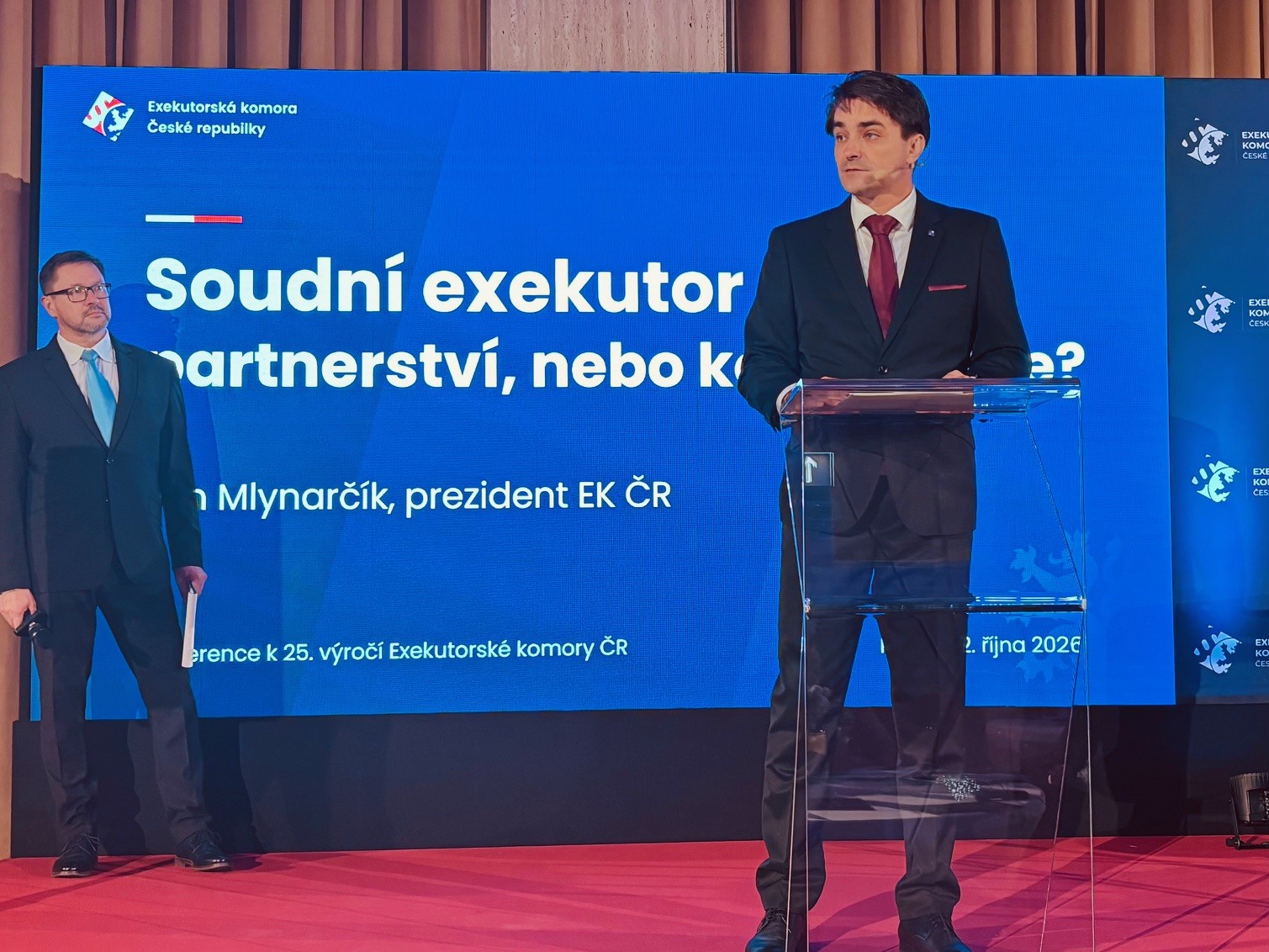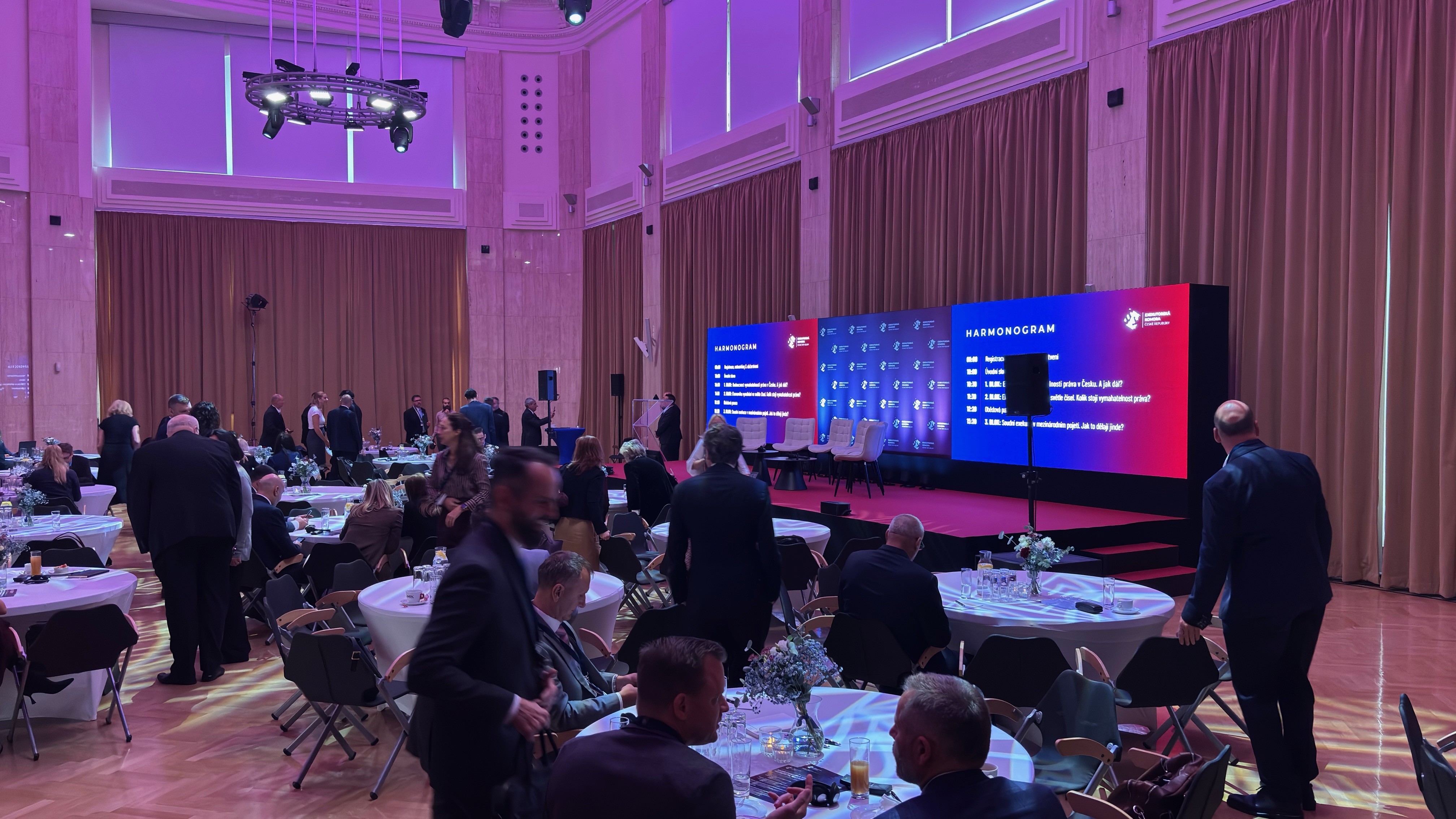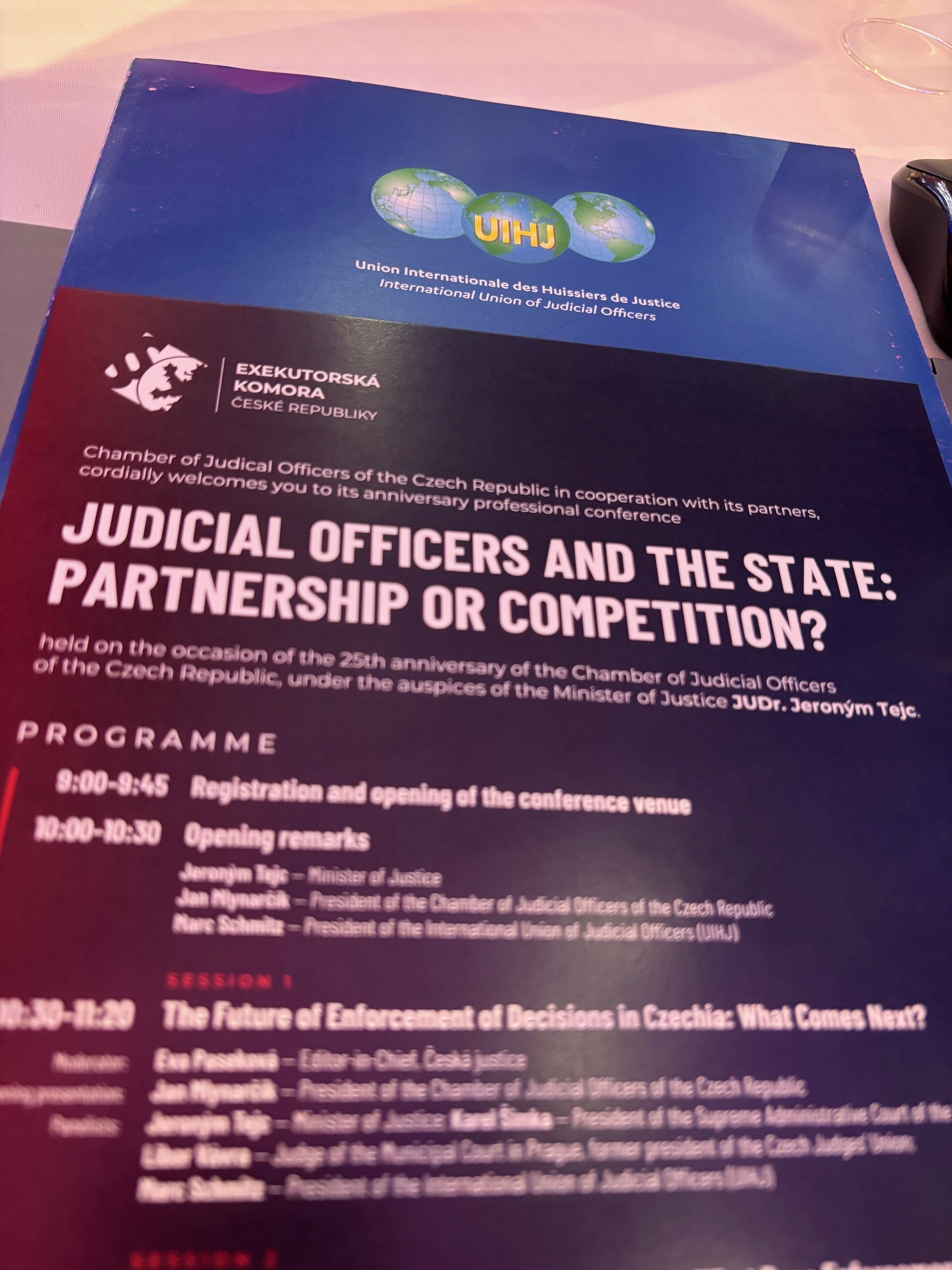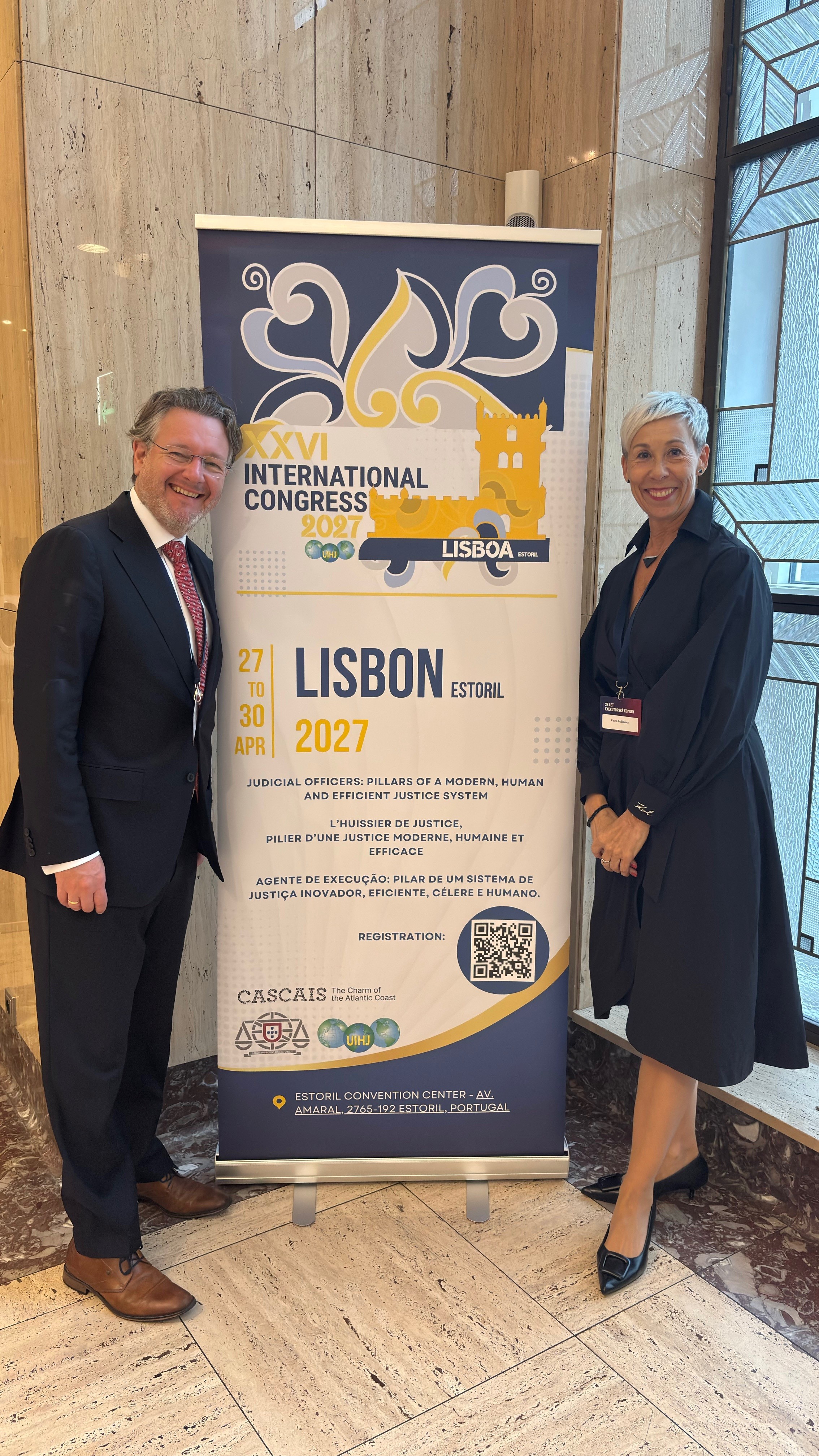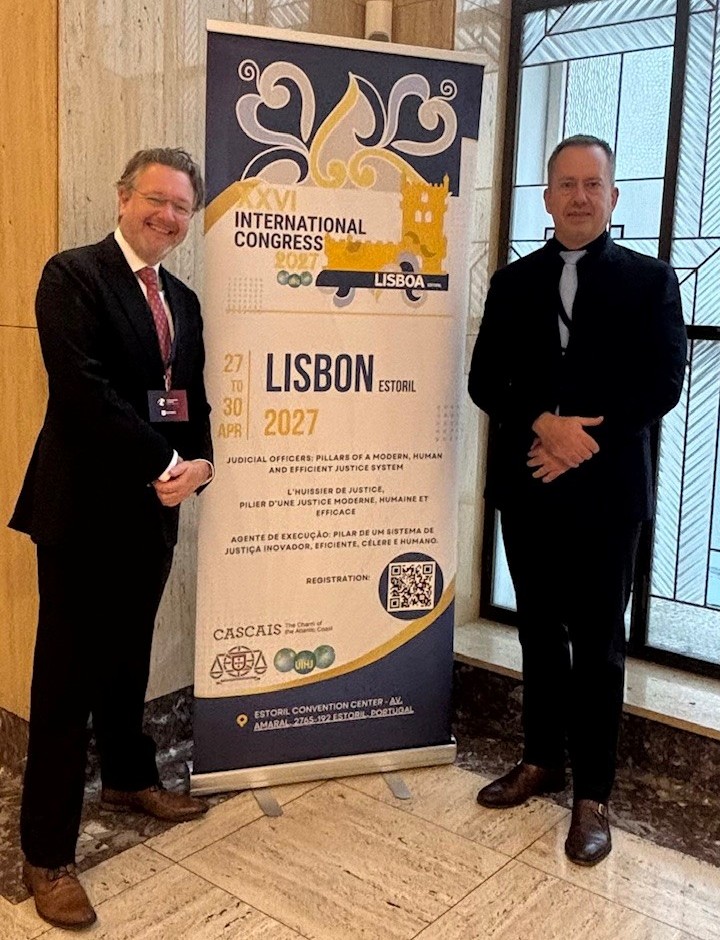
To mark its 25th anniversary, the Chamber of Judicial Officers of the Czech Republic held a professional conference in Prague on 22 October 2026. The International Union of Judicial Officers (UIHJ) was represented by Marc Schmitz, President, Elin Vilippus, Secretary, and Patrick Gielen, Secretary General. The European Union of Judicial Officers (UEHJ) was represented by Robert Cicuto, Treasurer, together with Doreen Donner and Oscar Mathieu Jans, both members of the UEHJ.
The conference was held under the auspices of the Minister of Justice, JUDr. Jeroným Tejc, on the theme “Judicial officers and the State: partnership or competition?”. It took place in the Commodity Exchange Hall of the Czech National Bank Congress Centre. The proceedings were chaired by Mgr. Pavel Tintěra, member of the Chamber’s Presidium.
The opening session brought together Jeroným Tejc, Minister of Justice, Jan Mlynarčík, President of the Chamber of Judicial Officers of the Czech Republic, and Marc Schmitz, President of the UIHJ. In his address, Marc Schmitz recalled that justice does not end when a court delivers its judgment. The enforcement of court decisions is an essential component of justice itself. The State and judicial officers must therefore be partners, not competitors. He summed up his message in one phrase: trust is the oxygen of justice.
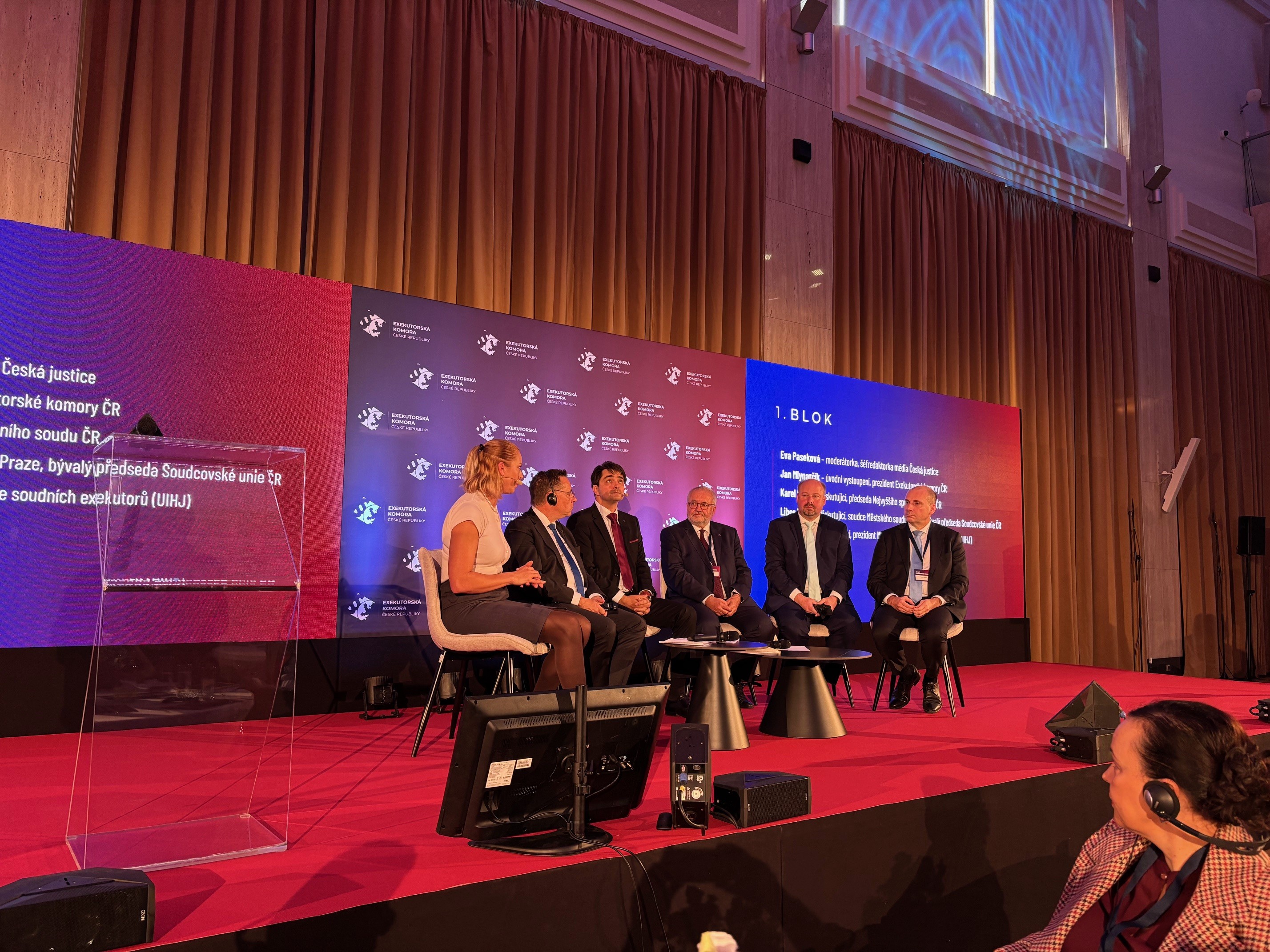
The first session focused on the future of the enforcement of court decisions in the Czech Republic. Following an introductory presentation by Jan Mlynarčík, a panel moderated by Eva Paseková, editor-in-chief of Česká justice, brought together the Minister of Justice, Karel Šimka, President of the Supreme Administrative Court, Libor Vávra, President of the Czech Union of Judges, and Marc Schmitz.
The discussion highlighted the importance of judicial officers keeping control over the enforcement of court decisions. It was stressed that a creditor, in this case the State, enforcing a decision that concerns it is not in line with European and international rules. Enforcement requires an independent actor who upholds the rights of both the creditor and the debtor.
Marc Schmitz pointed out that in Belgium, only judicial officers are competent to enforce court decisions, whether the creditor is a private party or the State. In his view, this is a matter of efficiency. He also cited the example of Bulgaria, where State judicial officers and private judicial officers work side by side. The creditor chooses which judicial officer to work with, and 90% of the work is carried out by private judicial officers, simply for reasons of efficiency.
The second session addressed the cost of enforcement, with figures to support the analysis. It was introduced by Martin Tunkl, Vice-President of the Chamber, and moderated by Jan Novotný, deputy editor-in-chief of e15. The speakers were Zdeněk Zajíček, President of the Czech Chamber of Commerce, Štěpán Křeček, chief economist at BH Securities, and Tomáš Goláň, former chair of the Senate Committee on Constitutional and Legal Affairs.
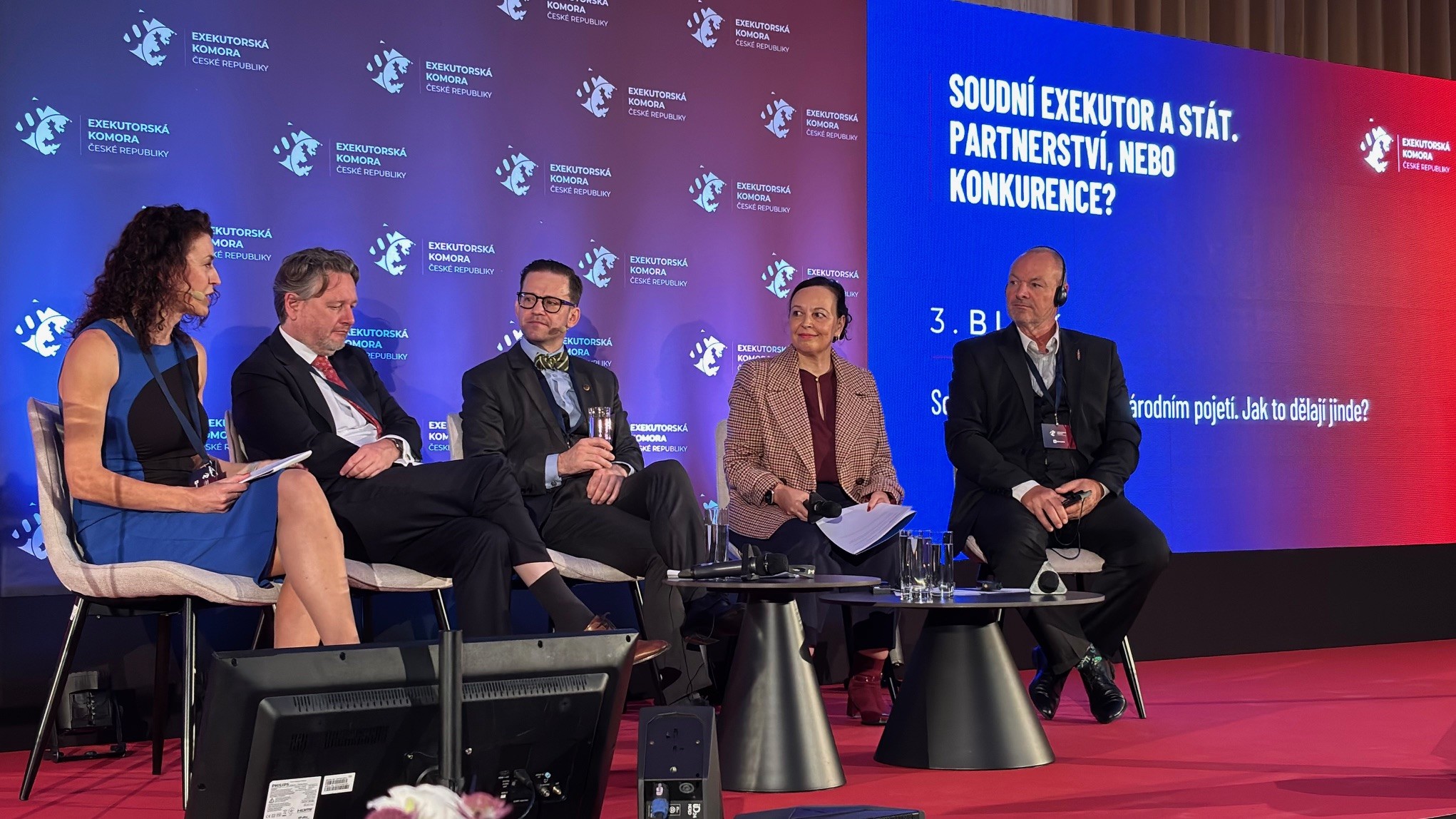
The third session, moderated by Tereza Lungová, member of the Chamber’s international committee, opened the debate to the international level. Oscar Mathieu Jans, judicial officer in Groningen (the Netherlands), presented the Dutch debt collection systems and the powers of judicial officers beyond debt collection. Doreen Donner, Obergerichtsvollzieherin at the Local Court (Amtsgericht) of Sömmerda (Germany), explained the so-called “Berlin eviction” (Berliner Räumung), a simplified form of eviction.
The panel also included Risto Sepp, judicial officer in Estonia, who spoke about the seizure of modern assets and a single point of access to registers of debtors’ assets. JUDr. Ing. Miroslav Paller, President of the Slovak Chamber of Judicial Officers, presented electronic tools supporting the seizure of motor vehicles.
The UIHJ and the UEHJ extend their warmest congratulations to the Chamber of Judicial Officers of the Czech Republic and to its President, Jan Mlynarčík, on this 25th anniversary, and thank them for their hospitality.