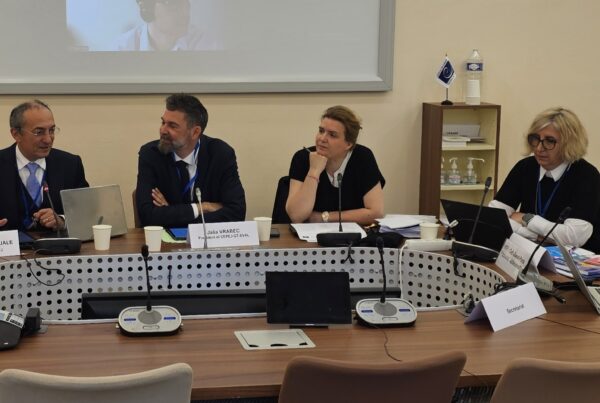
The UIHJ participated in the first meeting of the CEPEJ-GT-EFF at the Maastricht courthouse on 30 March and 1st April 2026. The UIHJ was represented by Jos Uitdehaag, First Vice-President, and Mathieu Chardon, Former First Vice-President.
Francisco Depasquale, President of the CEPEJ, specified that the CEPEJ-GT-EFF is now continuing the work of the CEPEJ working group on Judicial Time Management of (GT-SATURN), which he warmly thanks, as well as its president, Giacomo Oberto, for their accomplishments over 20 years. The CEPEJ-GT-EFF is responsible for developing methods of analysis and evaluation of work undertaken within judicial systems, as well as tools to improve the efficiency of justice and enable member states to implement policies aimed at preventing any violation of Article 6 of the European Convention on Human Rights, in particular the right to a fair trial within a reasonable time. The enforcement of court decisions and other enforceable instruments falls within its mandate, including the possible revision of CEPEJ’s tools in this area. Muriel Décot, Executive Secretary of CEPEJ, welcomed the new group and wished them every success in their work.
The six members of the CEPEJ-GT-EFF are Ana Bilic Andrijanic (Bosnia and Herzegovina), Ivan Crncec (Croatia), who was appointed chair, Francesco Depasquale (Malta), Ombeline Mahuzier (France), Sabine Matejka (Austria), and Pawel Wrzaszcz (Poland). The two deputy members are Marta Garcia de Vicunda Unda (Spain) and Ketevan Tsintsadze (Georgia). Three experts are also associated to the group: Kaspars Berkis (Latvia), Dimitrije Šujerranivić (Serbia), and Christian de Valkeneer (Belgium).
Regarding the enforcement of court decisions and other enforceable instruments, Jos Uitdehaag presented the various existing tools of the CEPEJ in this area: study no. 8 on the enforcement of judicial decisions in Europe, recommendations Rec(2003)16 of 9 September 2003 on the enforcement of administrative and judicial decisions in matters of administrative law and Rec(2003)17 on enforcement of 9 September 2003, the CEPEJ Guidelines on enforcement of 17 December 2009, and the 2015 Good practice guide on enforcement. He recalled that the UIHJ was consulted in the drafting of recommendation Rec(2003)17, participated in the creation of the Guidelines on enforcement and was tasked with drafting the Good practice guide on enforcement. In parallel, he mentioned the UIHJ Global Code of Enforcement (2015-2025) and UNIDROIT’s Best Practices in Enforcement (2026).
He suggested revising the 2009 Guidelines on Enforcement to reflect developments since then, particularly in information and communication technologies and artificial intelligence. He also addressed the importance of the human factor in enforcement, the changing attitudes regarding the role of the enforcement agent, who is increasingly involved in proposing solutions for unpaid debts, thereby reducing the number of cases brought before the courts, enforcement of digital assets, data protection, cybersecurity, access to information concerning debtors’ assets, mediation and alternative dispute resolution methods, professional standards for enforcement agents’ offices, and enforcement fees. To this end, he suggested the creation of a small working group to propose amendments to these guidelines. This proposal to form a working group was immediately approved.
Other items on the meeting’s agenda included discussions on the draft study on ways to reduce the length of the stages of civil proceedings, conducted by Guillaume Dartigue and presented by Pawel Wrzaszcz. An exchange of views focused on strengthening and expanding the CEPEJ’s Resource Centre on Backlog Reduction Practices. The CEPEJ-GT-EFF also discussed the draft concept note on for the guidelines for implementing workload measurement systems in courts, presented by Alexandre Palanco and Ana Krnić-Kulušić, and the way forward. Discussions also covered a checklist for effective, efficient, ideal and modern administrative and judicial court management, the training curriculum on efficient court management, proposals for potential tools aimed at reducing duration of judicial proceedings, the activities of the CEPEJ Network of Pilot Courts, and the work-life balance tool.
Jos Uitdehaag also attended the visit to the Limburg Pilot Court, as well as, on 31 March 2026 in Maastricht, the 19th meeting of the CEPEJ Network of Pilot Courts.