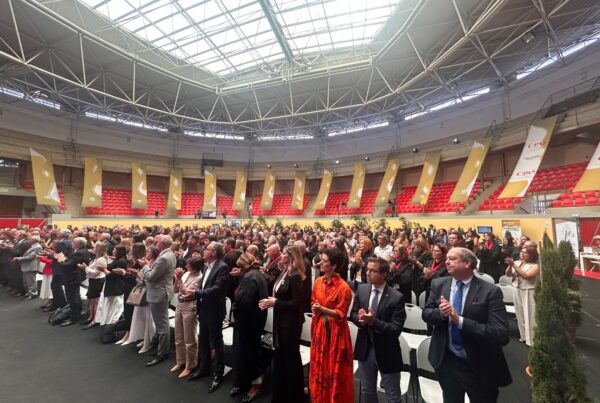

The UIHJ, represented by Patrick Gielen, Secretary General, participated on 10 March in the conference organised on the theme “Artificial Intelligence and Legal Professions: Potential, Challenges and Risks”, which took place in Penafiel (Portugal), at Ponto C, under the auspices of the Consultative Council of the Porto Este Judicial District.
This event brought together a wide range of judicial and academic stakeholders to discuss the impact of artificial intelligence on legal systems. Judges, prosecutors, lawyers, enforcement agents and academics exchanged views on the ongoing transformation of legal professions, addressing both practical implications and the need to safeguard fundamental rights.
On this occasion, Patrick Gielen spoke during the session dedicated to “Artificial Intelligence and Legal Professions: Responsible Innovation in Judicial Enforcement”. His intervention highlighted the key role of judicial officers in this evolving environment, stressing that the integration of artificial intelligence into enforcement procedures must go hand in hand with strong guarantees in terms of transparency, human oversight and respect for fundamental rights.
The contribution of Anabela Veloso, bastonaria of OSAE, within the same panel, further enriched the discussions by providing additional insights into the practical and ethical challenges linked to the use of artificial intelligence by legal professionals.
A particularly striking element of the conference was the participation, during the afternoon roundtable, of an AI-generated avatar, illustrating in a tangible way the technological developments currently underway and prompting reflection on the future role such tools may play within legal processes.
The discussions clearly demonstrated that, in the face of the rapid development of artificial intelligence, no legal profession can act in isolation. The regulation, governance and effective use of these technologies require a strong interprofessional approach, based on cooperation between judges, lawyers, judicial officers, academics and public authorities. Only through such collaboration will it be possible to ensure an ethical, secure and efficient use of artificial intelligence, while preserving the balance of justice systems and maintaining public trust.
Through its active participation, the UIHJ reaffirms its commitment to a well-managed digital transformation of justice, grounded in dialogue between professions and the development of common standards, in full respect of the rule of law.