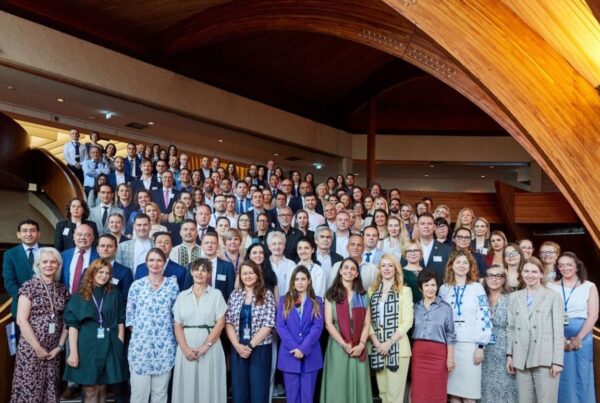

Organized by the National Chamber of Private Judicial Officers of Kazakhstan, the international conference held in Almaty on 11 June 2025, on the occasion of the 18th World Day of the Judicial Officer, brought together over 250 participants from 24 countries. This major event offered a platform to exchange views on the contemporary challenges of enforcement in the age of artificial intelligence and digital tools.
The UIHJ was represented by Marc Schmitz, President, Jos Uitdehaag, First Vice-President, Mohamed Reda Bougrine and Paulo Teixeira, both members of the Board, and Patrick Gielen, Secretary General. The UEHJ was represented by Oscar Jans, Secretary, and Duarte Pinto, Executive Committee member.
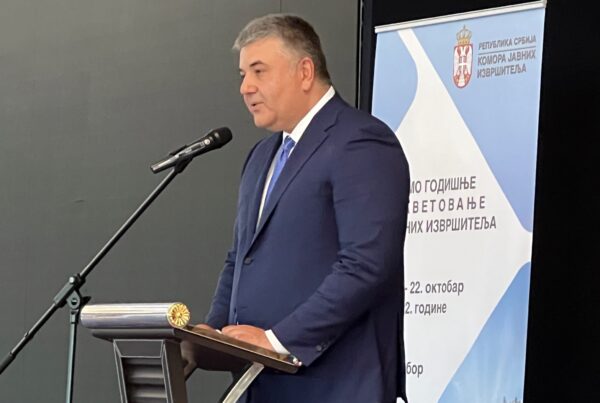
The opening ceremony featured high-level addresses from M. Makhsat Balabekov, chairman of the enforcement committee of the Ministry of Justice of the Republic of Kazakhstan, UIHJ President Marc Schmitz, and several institutional representatives: Dmitriy Koloda, Member of Parliament and Legislative Commission member, Shakir Shayakhmetov, First Deputy of the Judicial Administration, Kairat Raisov, Senior Adviser to the Prosecutor General, and Aidos Imanbayev, President of the National Chamber of Private Judicial Officers of Kazakhstan. All speakers highlighted the importance of international cooperation and innovation within legal professions.
The first part of the day was dedicated to artificial intelligence and digital tools in enforcement procedures. Jos Uitdehaag, UIHJ First Vice-President, introduced the theme by presenting key findings from the European Law Institute (ELI) report on the enforcement of digital assets, to which he made significant contributions.
In the first panel, also moderated by Jos Uitdehaag, several experts spoke. Marc Schmitz emphasised the need to innovate in enforcement to ensure more effective and accessible justice, highlighting UIHJ-led pilot projects. Professor Abay Magauiya, Head of the “IT & Law” Department at SDU University, explored the structural impact of AI on legal frameworks. Paulo Duarte Pinto, UEHJ Executive Committee member, focused on ethics and accountability in AI usage by legal professionals, stressing the necessity of keeping such tools human centred. Tatjana Afanasyeva, private judicial officer in Estonia, underscored AI’s potential to reinforce transparency, independence, and efficiency in the profession.
The second panel, moderated by Aitbek Amangeldy, delved into the practical applications of digital tools. Patrick Gielen, Secretary General of the UIHJ, analysed the impact of generative AI on daily legal work, highlighting both opportunities (automation, drafting, translation) and risks (disinformation, rights violations). Maral Zeiltayeva described Kazakhstan’s digitalisation efforts, including the development of interconnected platforms and automated case management. Ana Arabuli, Head of International Relations at Georgia’s National Bureau of Enforcement, shared her experience with digital case management, noting its benefits and current limitations. Massimiliano Blasone, lawyer in Italy and expert for the CEPEJ cyberjustice group, warned of possible infringements on fundamental rights and advocated for ethical and responsible AI governance.
The second part of the day addressed the challenges of enforcing child support obligations. Jean-Marc Pellet, iSupport Programme Coordinator at the Hague Conference, opened the session with an overview of cross-border recovery issues, international cooperation mechanisms, and the role of digital tools in overcoming legal obstacles.
In the following panel, moderated by Judge Aibek Amangeldin, Oscar Jans presented the Dutch system ensuring child support payments, emphasizing its administrative efficiency. Todor Lukov, judicial officer in Bulgaria, detailed the national legal framework which prioritises these debts, with the State assuming a guarantor role. Vesna Delovska, President of the Chamber of Judicial Officers of North Macedonia, described national practices and legislative adaptations to meet European standards. Mohamed Reda Bougrine, UIHJ Board member, discussed the situation in Algeria and efforts made to improve enforcement, particularly in rural areas.
Finally, a closing panel moderated by Patrick Gielen focused on the central question: how to improve child support recovery? Jean-Marc Pellet highlighted the progress made through the iSupport project and advocated for its widespread use. Galymbek Smagulov, from the National Chamber of Private Judicial Officers of Kazakhstan, presented the local challenges and suggested practical solutions. Paulo Teixeira offered an integrated approach combining innovation, training, and institutional cooperation. Roman Talmaci, President of the Chamber of Judicial Officers of Moldova, accompanied by Liliana Parfentiev, outlined recent reforms regarding the international mobility of children and the transfer of maintenance obligations.
The day concluded with an award ceremony in which Irak Yelekeyev received the Jacques Isnard Gold Medal from UIHJ President Marc Schmitz, in recognition of his pivotal role in establishing and strengthening the liberal status of judicial officers in Kazakhstan.
On 12 June, a convivial atmosphere took over from the scientific discussions with an international football tournament held in honour of World Day. The Almaty team triumphed in the competition, while the UIHJ international team put up a valiant fight in their matches against the Kazakh and Moldovan teams. Delegations from Morocco and Kyrgyzstan also took part enthusiastically. Comprising representatives from several continents, the UIHJ team demonstrated courage, teamwork, and solidarity right up to the final whistle.
During his visit to Almaty on the 2025 World Day of the Judicial Officer, the President of the International Union of Judicial Officers (UIHJ), Mr. Marc Schmitz, held a series of high-level bilateral meetings aimed at strengthening institutional relations and supporting ongoing reforms in the field of enforcement in the region.
On the morning of June 11, Mr. Schmitz met with Mr. Dmitry Koloda, Member of the Parliament of the Republic of Kazakhstan. Mr. Koloda, who is particularly active in legal matters, is the initiator of several legislative amendment proposals concerning the profession of judicial officers and expressed strong support for the initiatives promoted by the UIHJ. He then met with Mr. Shakir Shayakhmetov, First Deputy Head of the Judicial Administration of the Republic of Kazakhstan. The meeting focused on perspectives for international cooperation. Mr. Shayakhmetov, a regular participant in the work of the European Commission for the Efficiency of Justice (CEPEJ), emphasized the importance of continuous dialogue between national judicial institutions and international organizations.
In the afternoon of the same day, President Schmitz held a meeting with Mr. Kanatbek Osmonov, Deputy Director of the Judicial Department under the Supreme Court of the Kyrgyz Republic. Discussions centered around the reform currently underway in Kyrgyzstan to introduce a system of private judicial officers, as part of the national justice development program signed in 2023. Mr. Osmonov presented the main outlines of the draft law currently being prepared.
Finally, on June 12, Mr. Schmitz met with Mr. Yerlan Sarsembayev, Minister of Justice of the Republic of Kazakhstan. Appointed earlier this year, Mr. Sarsembayev previously served as a judge of the Constitutional Court. He reaffirmed the support of the Kazakh authorities for the UIHJ and expressed his commitment to further enhancing the digitalization of enforcement proceedings.
These meetings strengthened the institutional cooperation between the UIHJ and the judicial and governmental authorities of Central Asia, reaffirming a shared commitment to effective and modern enforcement of judicial decisions.
The UIHJ and UEHJ warmly thank the National Chamber of Private Judicial Officers of Kazakhstan and its President, Aidos Imanbayev, for the exemplary organization of this event rich in exchange, projects, and friendship.