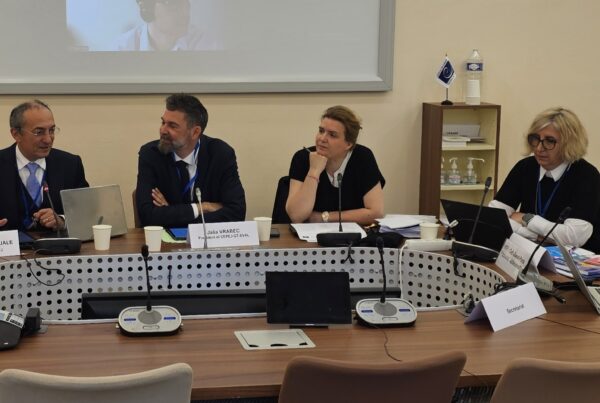

The UIHJ, represented by its former First Vice-President, Mathieu Chardon, participated in the 44th plenary meeting of the Council of Europe’s European Commission for the Efficiency of Justice (CEPEJ) on 4 and 5 June 2025, at the Palais de l’Europe in Strasbourg.
On the occasion of Malta’s Presidency of the Council of Europe from May to November 2025, Jonathan Attard, Malta’s Minister of Justice and Construction Sector Reform, graced the opening ceremony of the meeting with his presence. He reaffirmed Malta’s commitment to the Rule of law and human rights. He welcomed Francesco Depasquale, CEPEJ member for Malta since 2007 and current CEPEJ President. He emphasised the importance of the CEPEJ and its working groups, including the one on Cyberjustice, in developing the efficiency of justice and strengthening the rule of law.
Gianluca Esposito, Director General of Human Rights and Rule of Law at the Council of Europe, thanked all CEPEJ members and experts for their work to strengthen the Rule of law and human rights. He welcomed the CEPEJ’s decision to implement an annual data collection cycle instead of the current two-year cycles used to evaluate European judicial systems. He also highlighted the CEPEJ’s development of tools related to the digitalisation of justice and artificial intelligence.
Representatives from Albania, Azerbaijan, Belgium, Bosnia and Herzegovina, Croatia, Italy, North Macedonia, Morocco, Spain, Turkey, Ukraine, and United Kingdom, presented the recent developments in the field of justice in their respective countries since the 43rd CEPEJ plenary meeting in December 2024.
Seçkin Koçer, Chair of the ad hoc Working Group on Work-Life Balance (ad hoc CEPEJ-GT-WLB), explained the reasons why this working group was created, to address the challenges faced by judges. He mentioned the dissemination amongst the CEPEJ members of a questionnaire on work-life balance for judges with the aim to draft guidelines.
Jaša Vrabec presented the ongoing work of the Working Group on the Evaluation of Judicial Systems (CEPEJ-GT-EVAL) which he chairs. He detailed the preparation of the CEPEJ evaluation report on European judicial systems, 2026 cycle (2025 data), and the reform of the evaluation cycle (one year instead of two). Christel Schurrer, Deputy-Secretary of the CEPEJ and Secretary of the CEPEJ-GT-EVAL, mentioned the support for national correspondents, the ad hoc data collection for 2024, the cooperation with the European Union within the framework of the EU Justice Dashboard, and the Justice Dashboard Eap (Eastern Partnership countries). Enes Sehic, CEPEJ Project Manager, discussed the Western Balkans Dashboard.
João Arsenio De Oliveira then presented the ongoing work of the Working Group on Quality of Justice (CEPEJ-GT-QUAL) which he chairs, including the Guidelines on the quality of jurisdictional debate in civil and administrative matters, the checklist on access to justice, the child inclusive mediation, the interpretation in judicial proceedings, and the revision of the Handbook for conducting satisfaction surveys among court users. The cooperation activities in the field of quality of justice were presented by CEPEJ project managers Vafa Rovshanova, Leonid Antohi and Anastasiia Nohovitsyna.
Maria-Giuliana Civinni discussed the progress of the Working Group on Cyberjustice and Artificial Intelligence (CEPEJ-GT-CYBERJUST) which she chairs, particularly the generative artificial intelligence for judges, the ICT curriculum for judges, and the addendum to the Guidelines on videoconferencing in judicial proceedings. CEPEJ project managers Anastasiia Nohovitsyna, Enes Sehic and Emmanuel Baron, presented the cooperation activities in the field of Cyberjustice.
The CEPEJ-GT-CYBERJUST and CEPEJ-GT-QUAL are organising joint work on artificial intelligence (AI) which was discussed by Maria Giuliana Civinni and João Arsenio De Oliveira: Artificial Intelligence Advisory Board (AIAB), Resource Centre on Cyberjustice and Artificial Intelligence, and the piloting of the Assessment tool for the operationalisation of the European ethical charter on the use of artificial intelligence in judicial Systems and their environment.
Giacomo Oberto presented the ongoing work of the Working Group on Judicial Time Management (CEPEJ-SATURN) which he chairs, namely the database of backlog reduction practices, the case-weighting tool, the study on workload measurement in judicial systems, the tool to analyse the timeframes according to the steps of the civil procedure, and the meeting of the Network of pilot courts of the CEPEJ. The cooperation activities in the field of judicial time management were presented by CEPEJ project managers Laetitia Dimanche and Jovana Matic.
The CEPEJ observer members were also able to intervene. Regarding the UIHJ, Mathieu Chardon spoke to inform the CEPEJ members of the 18th World Day of the Judicial Officer, organised on 12 June 2025, around the theme of “Artificial Intelligence at the Service of the Judicial Officer, a Trusted Third Party.” He also announced the theme of the 26th International Congress of Judicial Officers, organised in Lisbon, Portugal, in early May 2027: “The Judicial Officer, Keystone of a Modern, Human and Efficient Justice”.