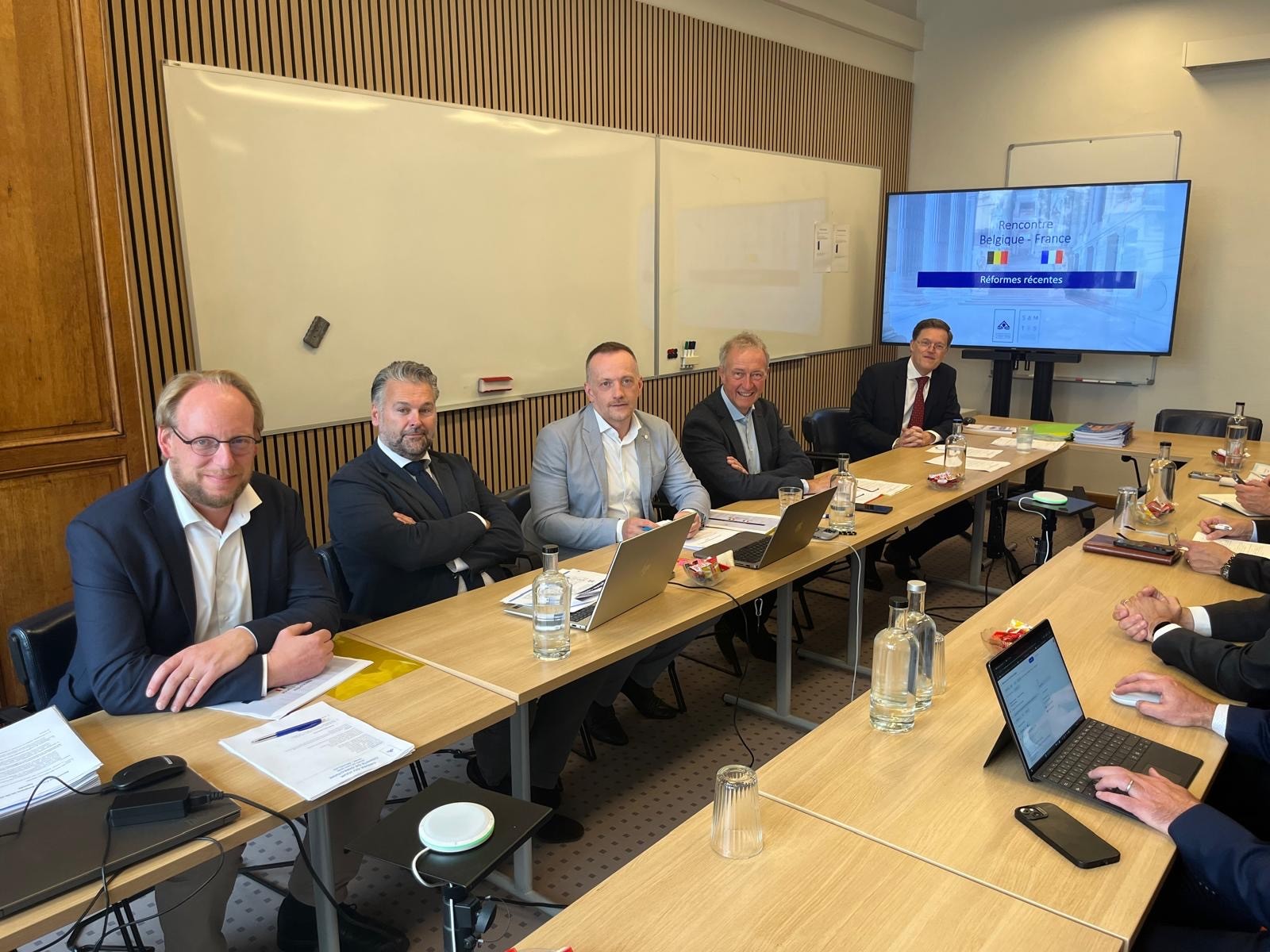
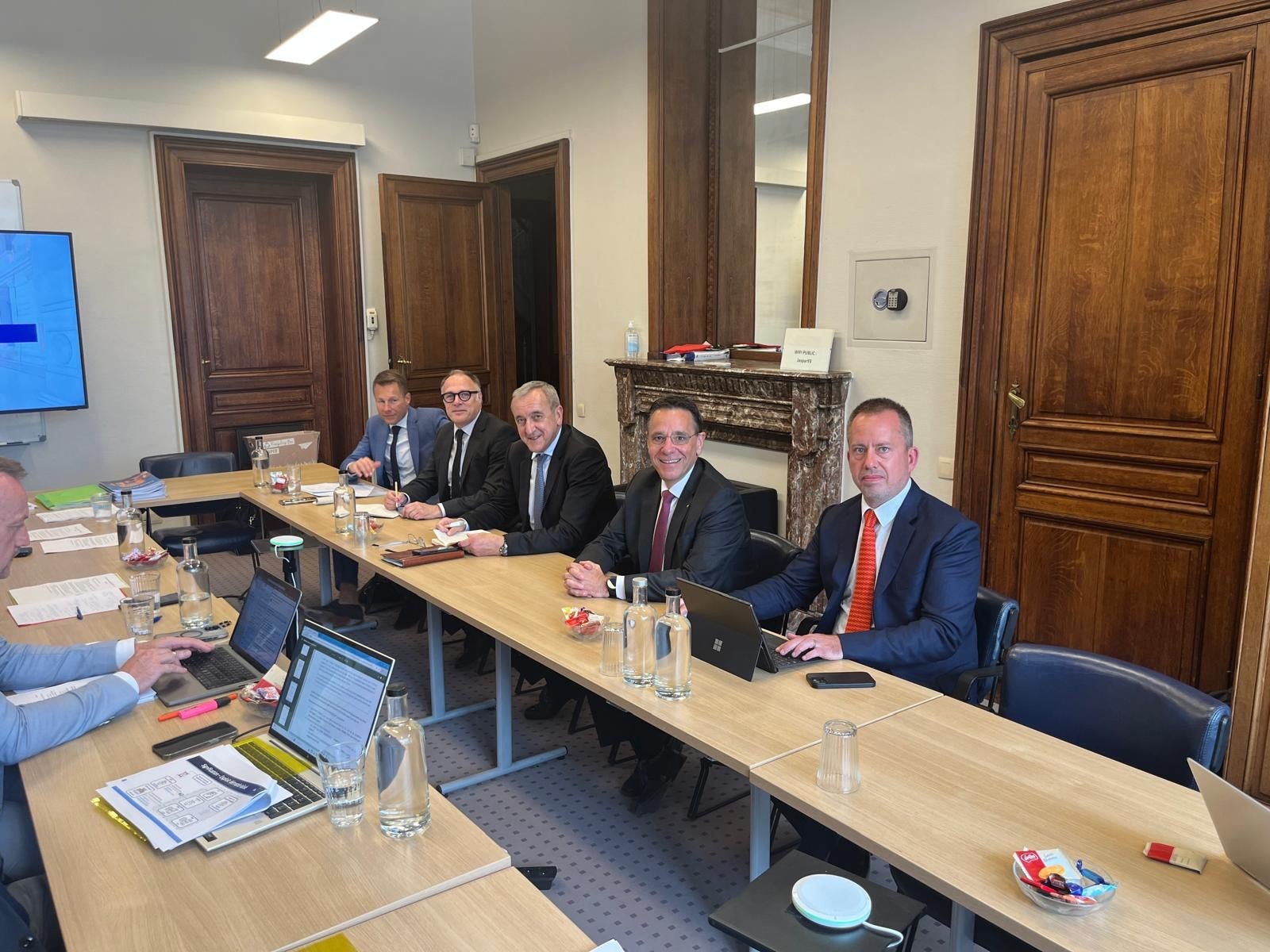
On 26 June 2025, the National Chamber of Judicial Officers of Belgium (CNHB) had the pleasure of hosting in Brussels a high-level working meeting bringing together a delegation from the National Chamber of Commissioners of Justice of France (CNCJ), composed of Mr Benoît Santoire, President, Mr Georges Golliot, Vice-President, Mr Jean-Pierre Herbette, Treasurer, and Mr Thierry Bary, General Delegate, as well as representatives of the International Union of Judicial Officers (UIHJ), Mr Marc Schmitz, President, and Mr Patrick Gielen, Secretary General, in order to engage in in-depth discussions on the evolution of the profession in Belgium and France.
The Belgian chamber was represented by Mr Quentin Debray, Francophone President, Mr Dominique Vaussort, Secretary, Mr Pascal Bodart, Rapporteur, Mr Laurent Tonnus, Treasurer, and Mr Nicolas Bouchelet, President of Sam Tes.
This meeting was part of a shared commitment to strengthening cooperation between the two professions on either side of the border. The discussions focused on recent and upcoming reforms that directly impact the work of judicial officers/commissioners of justice in both countries.
Key topics included the digitalization of procedures, notably the introduction of the digital original in Belgium from July 2026, tariff reforms, tools to combat over-indebtedness, and access to bank accounts to facilitate solvency investigations. France, for its part, shared developments in the field of reports and expressed interest in the Belgian advances in the recovery of commercial debts.
Special attention was given to e-CODEX, the European secure communication tool between judicial authorities. The participants considered the creation of a joint Franco-Belgian training programme to support its implementation.
Finally, the discussions addressed the development of the European report within the framework of the Regulation on the taking of evidence, as well as initial and continuing training of professionals in Belgium.
These rich and constructive exchanges underscore the importance of dialogue between sister institutions in anticipating changes in the profession and in affirming together the role of the judicial officer/commissioner of justice as a key player in a modern and effective justice system.